
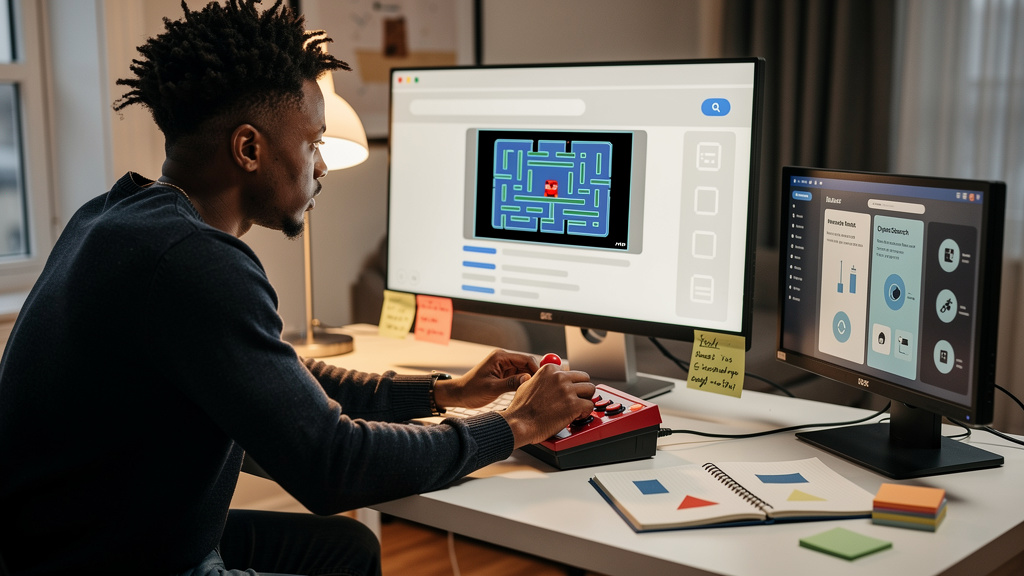
I had two tabs open and a half-drunk coffee when I typed the wrong thing into Google and watched a working copy of Space Invaders appear in my search results. It loaded in under three seconds. There was no install, no sign-in, and no ad asking me to subscribe. The game just sat there, mid-page, waiting. I ended up closing both real tabs and playing for about an hour. That has not happened to me with a browser game in years.
The whole thing is a single hidden command attached to a Google search property. You type the phrase, the result page sprouts a small play icon, and clicking it turns the search interface into a five-row formation of pixel aliens descending on a lone cannon. On a desktop you get arrow keys and space. On a phone you get three on-screen buttons. Both are free, both run in your browser, and neither wants anything from you.
Why a fifty-year-old arcade game still holds up in 2026
The original Taito cabinet from 1978 is older than the average software developer reading this. It survived five decades on the back of one insight: a game that fits on any screen, requires one input, and rewards attention over reflexes will keep working when flashier titles rot. The browser version Google hid inherits that insight. There is no progression system, no unlocks, no daily reward. You play until you lose, and then you play again, and then you go back to work.
Restraint is the other reason it survives. Modern web games compete for your time. They have streaks, push notifications, daily login bonuses, and dark-pattern pop-ups. This one has none of those. It is a coffee-break game, not a Saturday-afternoon game. Google never asks you to come back. The game is just there when you want it.
Most web toys in the same category share this restraint. The dinosaur game in Chrome, Google Snake, Google Pac-Man, Block Breaker, Google Gravity, and the rest all behave the same way. They are small, they are free, and they do not try to keep you. That is the entire pitch, and for five minutes between meetings it is more than enough.
The lesson the front row teaches you
Here is what bit me on my first four runs. The formation moves at the speed of its fastest survivor. Every alien you clear makes the survivors step sideways a fraction faster, and after two or three waves the rhythm compounds. By the middle of the game, the aliens on the front row are moving quickly enough that a single misread costs you a life.
The wrong reflex is to reach for the back rows. Back-row sniping feels productive because that is where the bigger points live, and you can rack up score without taking damage. Reaching for the back row is also the slowest way to reduce the formation’s speed, because the front-row aliens keep marching the whole time you are aiming at the deep ranks. By the time you thin the back, the front has crept low enough to start raining bombs on your cannon.
Better instinct, and the one that took me four runs to learn:
- The fastest alien left sets the pace. Take the metronome out first.
- Back-row sniping looks productive and is mostly a tax on your margin.
- Wave three punishes the sins of wave two. Plan ahead.
- The metronome principle is the only habit that survives every wave.
Shoot the alien that is moving fastest, regardless of where it sits in the formation. The fastest survivor is the metronome. Knock it out and the rest of the formation slows down for a moment, which gives you a breath to re-aim. The points are lower, but the breath is worth more than the points.
Where cover falls apart and how to stay alive
The four shields between your cannon and the aliens look like the obvious place to hide. They are not. Each shield crumbles from two directions at once. Bombs dropped by the formation chew the upper half. Your own laser bolts carve through the lower half whenever you fire from directly underneath. I lost three waves in a row before I caught on to the second half of that equation. I was the one dismantling my own defenses while telling myself I was defending them. That was embarrassing enough that I want to call it out for you.
The fix is one habit. Stop parking underneath the shields and start parking next to them. Step a few pixels to the left or right, fire, step back. The shield holds its shape for the early waves, which is the part of the run where the bombs are sparse and your margin is real. By the time the shield is chewed through on its own, the formation is usually so close that cover matters less than reflexes anyway. You lose a fraction of a second per shot because you spend more time moving and less time firing. On a perfect run that adds up to a few seconds total. On a run where you would otherwise have died at wave three, that fraction of a second is the reason you reach wave four.
A deeper lesson hides underneath that habit. The stand-next-to-cover habit is the one I see missing the most.
The bonus ship is a trap if you chase it
A small bonus ship drifts across the very top of the screen at random intervals. It is worth a chunk of points, which makes it the most tempting target on the board. The reflex is to track it with your eyes and try to be in the right column when it passes. That reflex loses runs.
Across about twenty attempts on my end, the bonus ship is fast. Moving to chase it usually means leaving the column you were already covering. More often than not, you miss the ship and lose a shield to a bomb that landed while you were looking up. The free points come when the ship happens to cross your current column while you are already in position. One shot, no movement, no risk.
Pick a column. Defend that column. Let the ship come to you. If a minute passes without seeing one, that is fine. The aliens are still the actual game, and the points on the bonus ship do not pay for a lost wave.
Trade-offs
Google Space Invaders is not free in time. The first run takes about twenty minutes if you actually want to feel the pressure curve across all five waves. The stand-next-to-cover habit costs a few runs to internalize. The phone controls work but are noticeably slower than the desktop layout, so the desktop version is the one you want for serious sessions.
The migration was about five minutes for me, mostly spent finding the trigger phrase the first time. Bookmark the URL or save the query that opens the game so you do not have to dig for it again. After that, it is a one-click habit. Anyone who wants a five-minute brain break between meetings will like this. Anyone looking for a deep, long-form game will not.
The honest read: this is a five-minute game that respects your time, and it is the kind of corner of the modern web I keep coming back to. Bookmark it, play it between meetings, and let the other browser toys collect dust until you are the right kind of tired.
Coach’s Note: Type the right phrase, click the play icon, and stand beside your shield on wave one. That one habit will outlive every other tip in this article.