
Every couple of years, a major tech company announces a moonshot that sounds too strange to be real. Google’s orbital machine learning bet is the latest one, and it deserves more scrutiny than the headline suggests, because the gap between a press release and a constellation in low Earth orbit is wider than almost any other gap in this industry. The honest read is that the idea is interesting, the engineering is brutally hard, and the only thing that matters over the next year is what survives the launch.
Here is a rubric for separating real orbital-compute bets from theatrical ones, and Suncatcher sits closer to the real end of that spectrum than most coverage implies, which is why it is worth understanding on its own terms.
What Suncatcher actually proposes
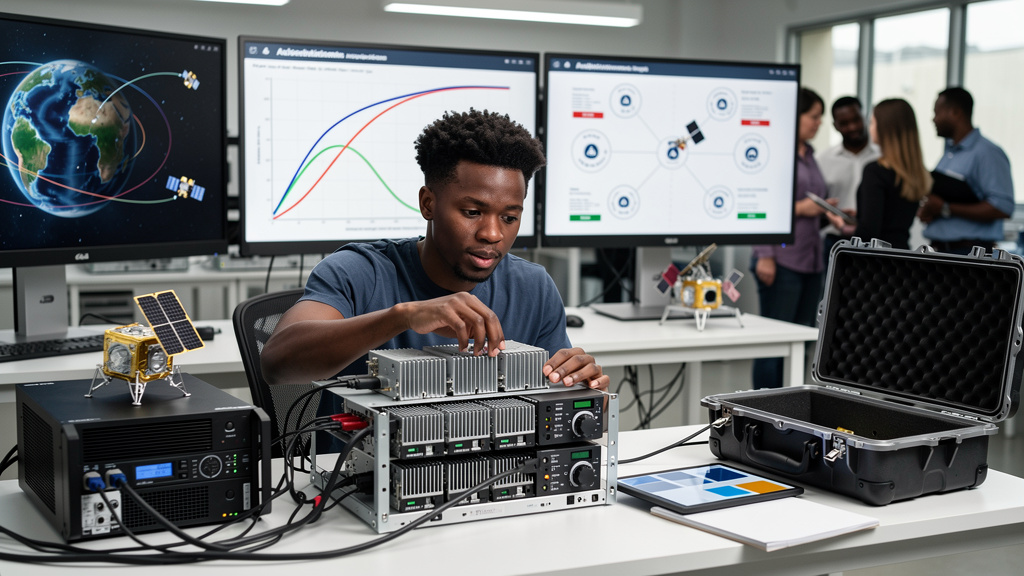
Strip away the headline, and Suncatcher is a flight test. Google wants to put a pair of satellites in low Earth orbit carrying the same kind of accelerator silicon the company uses to train Gemini on the ground, and it wants to measure how that silicon holds up across launch, vacuum, thermal cycling, and radiation exposure. The whole program fits inside a single SpaceX rideshare mission, and the value of the program lives or dies in the telemetry that comes back.
If the chips survive, the next step is a small constellation that uses the flight data to design a follow-on generation of hardware. If they do not survive, the program probably ends as a published research paper and a quietly shelved roadmap, which is how most honest engineering programs end when the physics does not cooperate.
A few framing notes worth pinning down:
- Suncatcher is a research program with a real flight, not a press release, and the prototype is already manifested on a SpaceX Transporter-class mission.
- The first generation uses Google’s own Tensor Processing Units rather than a third-party chip, which means the data the team collects is directly actionable for Google’s roadmap.
- Whatever data Google publishes will be the input to every other company’s decision about whether to follow, so the writeup matters as much as the flight.
- The strongest part of the case is the energy math, which is genuinely compelling on paper and is the reason the project is worth taking seriously at all.
Why low Earth orbit is so attractive for compute
On the ground, a fixed solar array sees sunlight for a fraction of the day, then weather, then night, then seasonal tilt. Up in low Earth orbit, a satellite sees near-continuous sunlight, which means a panel of a given size can produce up to roughly eight times more annual energy than the same panel mounted on a roof. Multiply that by a constellation’s worth of satellites and you have a compute fabric that effectively runs on perpetual solar energy, with no cooling bill, no grid permitting, and no local water draw.
The non-obvious part of the case is the capex shape. Ground data centers scale by pouring more concrete and signing more power purchase agreements, both of which take years and have environmental review attached. A satellite constellation scales by launching more satellites, which is expensive per unit but linear and time-bounded once cadence is established. If the launch math works, orbital compute becomes one of the few infrastructure categories where the marginal cost of capacity actually drops as you scale, which is rare.
The honest upside:
- Sunlight availability at orbital altitudes beats any ground solar deployment by a wide margin, even before accounting for weather.
- No data center cooling means no water draw and no cooling-tower permitting, which removes two of the largest frictions in modern ground-data-center construction.
- Constellation growth is a function of launch cadence rather than construction cadence, which compresses the time-to-capacity once the design is mature.
- Once a satellite is in orbit, weather and gravity stop being failure modes for the compute hardware itself, which simplifies operations dramatically.
Read those four together and the appeal is clear. The cost of a marginal AI training run on the ground keeps climbing, and orbital compute is one of the few ideas on the table that might bend that curve the other way over the next decade.
Why the launch window is the real bottleneck
Here is the brutal part that most coverage glosses over. Reaching orbit takes roughly ten minutes, and that ride is the single most violent stretch any commercial chip will ever experience. The payload rides through pounding vibrations, acoustic shock, and acceleration that can reach one hundred times Earth’s gravity. That is not a number you engineer around with clever packaging. It is a property of the rocket, and every chip on the satellite has to survive it.
After launch comes vacuum, then thermal cycling as the satellite orbits in and out of direct sunlight, then steady bombardment by cosmic rays that Earth’s magnetic field normally filters out for everything living on the ground. Each of these is a separate engineering problem, and the same chip has to survive all three to be useful.
Honest framing of the constraints:
- Launch forces can reach one hundred Gs, which is far beyond any consumer silicon warranty rating.
- Cosmic rays flip memory bits, so error correction overhead becomes a real-time engineering problem that does not exist on the ground.
- Vacuum changes how heat moves through a chip package, which can shift thermal design in ways that ground testing only partially predicts.
- Replacing a failed satellite costs roughly the same as launching a new one, which means failure rates have to stay low or the math collapses.
If the prototype chips survive this gauntlet, the program has a real path to a constellation. If they do not, the program probably does not scale past a small number of test vehicles and ends as a published result.
Trade-offs
A few honest ones to weigh before you decide whether orbital compute is going to matter to your work:
- This is an extra compute layer, not a replacement for ground data centers, and the workloads that move up there will be the ones where energy and cooling matter more than round-trip latency.
- Radiation-hardened parts cost more than commodity parts, so the energy-cost savings have to clear the parts-cost delta before they show up on a P&L.
- Launch access is finite and expensive, which means a real constellation takes years of cadence and budget rather than one successful demo.
- Latency to and from orbit is higher than fiber between ground data centers, so anything that depends on tight round-trips will not run in space.
If those trade-offs sound acceptable, the program is worth tracking closely. If any of them are deal-breakers for the workloads you care about, the right move is to wait for actual flight data before forming a strong opinion.
How to actually track this without becoming an aerospace nerd
You do not need to read every launch manifest to follow this. Here is the minimum useful watchlist:
- Google’s research blog, where Suncatcher data drops will land first and where the team will publish its findings regardless of whether the chips survive.
- The radiation-hardened chip design space, because that is the real bottleneck and the area where the most consequential follow-on engineering will happen.
- The competitor announcements, because the moment Google’s data is public, every other cloud provider will either follow or explain why they are not.
- The actual launch and orbital-insertion coverage, which is where the first hardware-verification moments will arrive.
The single best discipline you can bring to this kind of story is patience. Headline announcements tell you what a company is hoping for. Flight results tell you what is real. Most of the truly important signal in this category arrives months after the press cycle has moved on, which is exactly when most casual observers stop paying attention. If you can keep your eye on the data drops and ignore the launches as spectacle, you will see the actual story before it becomes consensus.
You do not need to care about satellites to take something useful away from this. The pattern is recognizable in any category of large infrastructure bet. There is a clever idea, a punishing physical constraint, and a small group of people willing to put real hardware through that constraint to find out whether the idea holds. That is how breakthroughs happen, and it is also how budgets disappear. Hold out for the numbers, read them carefully when they land, and update your view only when the evidence demands it.