
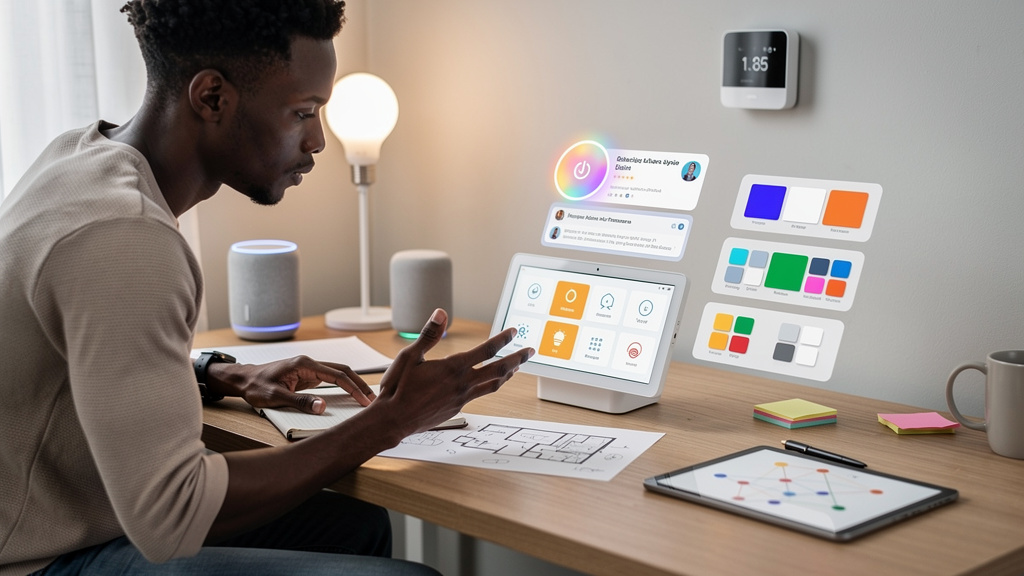
Google’s new Home Speaker costs $99 and replaces the discontinued Nest Mini. It also has the misfortune of sitting on the shelf next to a five-year-old Nest Hub that costs the same and does more. After a few weeks of running both in my apartment, I keep reaching for the display.
The Home Speaker is not a bad product. It is just the wrong product for $99 when the Nest Hub (second generation) is right there, still officially supported, and running the same Gemini for Home stack. The speaker’s pitch is sound quality. The display’s pitch is everything else.
What the Home Speaker actually does
The Home Speaker is a small orb that streams audio, listens for “Hey Google,” and routes Gemini for Home queries through Google’s cloud. Inside the shell sits a quad-core A55 processor and an NPU (neural processing unit, a chip dedicated to running AI inference locally rather than round-tripping every request to a server) that Google says is tuned for Gemini. Around the back are three far-field microphones and a physical mute switch, which is the right call. The omnidirectional 58mm driver is the headline feature, and the speaker does sound better than the Nest Hub at moderate volume. For a desk or a kitchen counter where music matters, that is a real edge.
For everything else, the Home Speaker is essentially a $50 Nest Mini in a nicer shell. Voice queries, routine triggers, and Gemini summaries all work the same way they do on every other Google smart speaker that has shipped since 2021. There is no screen, no camera, no Soli sensor (Google’s short-range radar chip, used for gesture control and presence detection), and no temperature sensor. The Home Speaker cannot display a recipe while you cook. It cannot show you a Nest camera feed. It cannot render a speed test result from your Nest Wi-Fi Pro router. It can answer all of those requests in audio form, and for some of them, that is fine. For the rest, audio-only feels like the early 2010s.
What the Nest Hub (2nd gen) does that the Home Speaker does not
Five years on, the Nest Hub is still officially supported. Google still sells it, still pushes firmware updates, and the on-board assistant is the same Gemini for Home stack that ships on the Home Speaker today. The 7-inch touchscreen is the obvious differentiator, and the moment you ask either device to do anything visual, the comparison ends.
Sensors are where the Nest Hub pulls ahead. Three sensors the Home Speaker skips. A temperature sensor feeds into Google Home routines, so a command like “lower the thermostat when the living room hits 74” actually works without a separate thermometer. An ambient light sensor dims the screen at night and brightens it during the day. The Soli radar chip detects movement and breathing close to the display, which powers Quick Gestures (a wave to pause music), presence sensing (the screen turns on when you walk into the room), and Sleep Sensing (a feature that tracks sleep from the nightstand). None of that is in the Home Speaker.
Microphone pickup is comparable across both devices. The Nest Hub’s speaker is smaller and quieter than the Home Speaker’s 58mm driver, and if your only use case is music, the Home Speaker wins that fight. For everything that benefits from a screen, the Nest Hub wins.
Voice requests feel different when there is a screen
This is the part I did not expect to care about until I lived with both devices for a week. When I ask the Nest Hub to set the Nest Thermostat to 70 degrees, the slider and temperature dial appear on the screen. If the temperature I asked for is not quite right, I can tap the number and adjust it. When I ask the Home Speaker the same thing, the speaker tells me the change happened, and that is all I get. Gemini tends to reply with longer spoken responses than the old Google Assistant did, and without a confirmation panel, that adds friction to every interaction.
A few more examples from real use:
- Recipes. Both devices can recite one out loud. Only the Nest Hub scrolls the steps as you cook.
- Wi-Fi diagnostics. Both can run a speed test through a Nest Wi-Fi Pro router. Only the Nest Hub shows the result on screen.
- Timers. Both can set a kitchen timer. Only the Nest Hub shows countdown rings on screen, and only the Nest Hub can run several at once without losing track.
- Camera alerts. The Home Speaker can announce a doorbell press. The Nest Hub shows the live feed alongside the chime so you can see who is there.
- Weather lookups. Both can answer “what is the weather tomorrow.” Only the Nest Hub shows the hourly forecast on the same screen.
None of this is a major shift in capability. It is just more useful in the same number of interactions.
Cameras are where the gap widens
I run a Nest Battery Doorbell and a couple of Nest Cam Indoor units. Gemini for Home is genuinely useful for camera queries, but only when there is a display to look at.
The Home Speaker can answer “what time did the courier drop off the package” in audio form. The Nest Hub answers the same question and then surfaces the relevant camera clip on the screen, complete with a timecode. If the question is vague (“show me anything that happened at the front door today”), the Home Speaker may give up. The Nest Hub shows a list of events from the day and lets me tap into whichever clip is interesting.
For someone with no Nest cameras, the screen matters less. For someone deep in the Google Home and Nest setup, the screen is the difference between “I have a smart speaker” and “I have a smart home control surface.”
Trade-offs
The Nest Hub is not a free upgrade. Picking it over the Home Speaker costs you a few things.
Sound quality is the obvious one. The 43.5mm full-range driver on the Nest Hub is smaller than the Home Speaker’s 58mm omnidirectional unit, and at higher volumes it compresses harder. If you mostly want background music in a kitchen or a home office, the Home Speaker sounds better for the same $99. You also give up the sleeker industrial design. The Home Speaker is a small orb that disappears on a shelf; the Nest Hub is a 7-inch display on a fabric-wrapped base, and it looks like a small display on a fabric-wrapped base.
There is also the aging risk. The Nest Hub (2nd gen) is five years old. Google still supports it, but the next generation of Gemini features may ship first on newer hardware, and the Nest Hub’s processor is slower than the Home Speaker’s A55 + NPU. In daily use today, the difference is invisible. In two or three years, it may not be.
Finally, if you do not own any Nest cameras, a Nest Thermostat, or a Nest Wi-Fi Pro, the screen advantage shrinks fast. For someone whose smart home is two bulbs and a Chromecast, the Home Speaker is the cleaner purchase.
Bottom line
If you already own any Nest camera, Nest thermostat, or Nest Wi-Fi Pro router, spend your $99 on the Nest Hub. The screen pays for itself the first time you ask a vague camera question and tap into the right clip without pulling out your phone.
Anyone whose smart home is just a couple of bulbs and a Chromecast should get the Home Speaker instead. It is louder, it is more compact, and it is the right product for that specific use case.
The one thing to remember: ignore the marketing that frames the Home Speaker as Google’s new flagship. The flagship is the one with a screen, and Google is still selling it.