
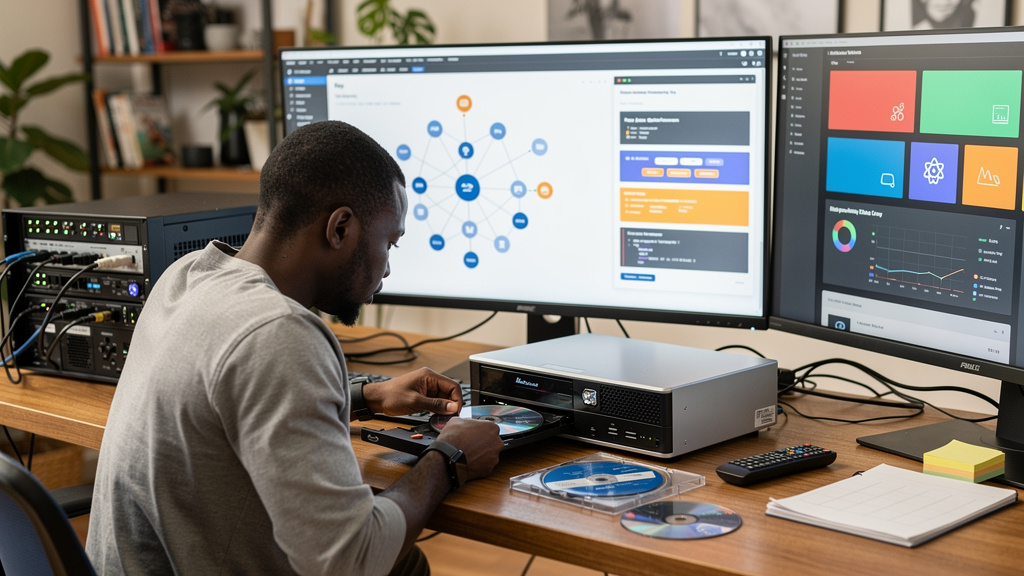
A friend handed me a stack of old Blu-rays during a move last year. I had not owned a working disc player since I cancelled my last subscription tier. I picked one up for twenty dollars from a local seller and spent a weekend watching what was on those discs. The picture quality was better than I expected. The extras were deeper than I expected. The thing that surprised me most was the loading time.
That last point is not what most people think about when they imagine going back to physical media. But the player booted faster than my streaming stick, the disc loaded in about a minute from cold, and there was no buffering, no quality downgrade when the network got busy, and no spinning wheel when I wanted to skip to the next chapter. The disc was the source. Nothing had to negotiate with anything.
I came out of that weekend with three specific things I had not expected to notice, and a sharper reminder of what I had given up when I cancelled the discs.
The first thing: I actually own these
When you check out a movie through a streaming storefront, you do not own a movie. You own a license to play it inside one app, on devices the storefront approves, at whatever picture quality it decides to give you that day. Studios can pull titles. Stores can close. Your purchases can disappear behind a banner saying the title is no longer available, and you cannot do anything about it.
I had this happen to me twice in the last few years. Two films I had paid for through a digital store were removed from the catalog when the studio moved the rights. The new storefront did not honor my purchase. The old storefront refunded me, which was nice, but I lost the films.
A disc in a case on a shelf does not work like that. It does not have a license agreement. It does not depend on a server somewhere deciding whether you are still allowed to play it. The disc works as long as you have a working player. That sounds old fashioned. It is also the only ownership model left in home video that still means what it says.
The second thing: the extras go deeper than I remembered
Studios used to put real effort into the bonus material because discs were the only way to sell a movie. Some titles carry commentary tracks that run for the full length of the film. Others have behind the scenes featurettes, deleted scenes, mini documentaries on the practical effects, or director intros that set up what you are about to watch.
I watched a documentary on the second disc of a film I had streamed twice. It was longer than anything the streaming version offered, and it was clearly made by someone who cared about the project. Streaming services have started adding some of this material back, but the depth is not the same. The studios know that on a streaming platform, most viewers will never click past the play button, so the extras are a smaller investment. On a disc, where the extras are the only way to differentiate your release from someone else’s, the extras were a selling point.
The extras I watched on those four discs were longer than the films themselves, in two cases. That is a real difference, and it is not coming back on streaming in the same form.
- Run time commentary tracks where the director, the writer, or a film scholar narrates the whole film
- Short films that go behind the stunts, the effects, or the production design
- An opening piece from the director or producer that sets up the film
- Scenes that were cut from the theatrical release
- Documentary style featurettes that show how the practical effects were built
The third thing: 1080p on a smaller screen looks better than I expected
On a small screen in a guest room, the difference between a Blu-ray and a streamed copy of the same movie is honestly more obvious than it is on a flagship TV in the living room. The pixels are bigger on the smaller screen, and the compression that streaming services use to keep bandwidth down shows up more easily at that size. A 1080p Blu-ray on a 1080p TV is the cleanest possible image for that screen, and most streaming services deliver lower bitrates than that even on a fast connection.
The difference is not life changing. It is the kind of thing you notice for the first twenty minutes and then stop noticing. But on the right screen it is the difference between a film that looks like a film and a film that looks like a heavily compressed video.
What streaming still gives me that a disc does not
I am not going to pretend a twenty dollar used player fixes everything. There are real costs that show up immediately.
- A month of streaming is cheaper than a single new release Blu-ray
- Searching across a thousand titles is faster than browsing a shelf
- A small apartment does not have room for shelves of cases
- Discs scratch, and a kid with a fork can ruin a side in seconds
- Region locked discs show up occasionally, and not every player handles every region
If any of those matter more to you than ownership and picture quality, stick with streaming. The honest case for physical media is narrow. It is for people who want to actually own a copy of a film they care about, who want the best version of it with the extras the studio made, and who are willing to deal with the costs above in exchange.
Trade-offs
Going back to physical media is not free in time. You have to maintain the discs. You have to find space for the shelves. The used player I bought came with a missing battery cover and a remote that needs line of sight. None of those are dealbreakers, but they are real costs that disappear when you stream.
For me, the math came out to owning three or four films I actually care about. New release Blu-rays still cost around twenty to thirty dollars each. Used ones go for a few dollars at thrift stores and online marketplaces. If you only watch whatever the algorithm picks for you, this is not worth it. If you have three or four films you want to actually own and rewatch, the cost is comparable to a few months of one streaming service, and you keep the films forever.
There is also the question of how long the format itself will last. Blu-ray has been around for almost twenty years and players are still cheap. Whether that holds for another twenty is unclear. The honest answer is that no format lasts forever, but a disc in a case has a much longer expected life than a streaming storefront that can disappear overnight.
Bottom line
Start with one movie. Find it used for under ten dollars at a thrift store or online marketplace. Buy a twenty dollar used player. Watch it once and see how it feels to load a disc, hear a clean soundtrack, and own something that will play tonight and ten years from now if you still have a working player. If you like the feeling, build a small collection of films you have rewatched more than three times. If you do not, you are out the cost of a single new release Blu-ray and you learned something useful about whether the trade-offs work for you.