
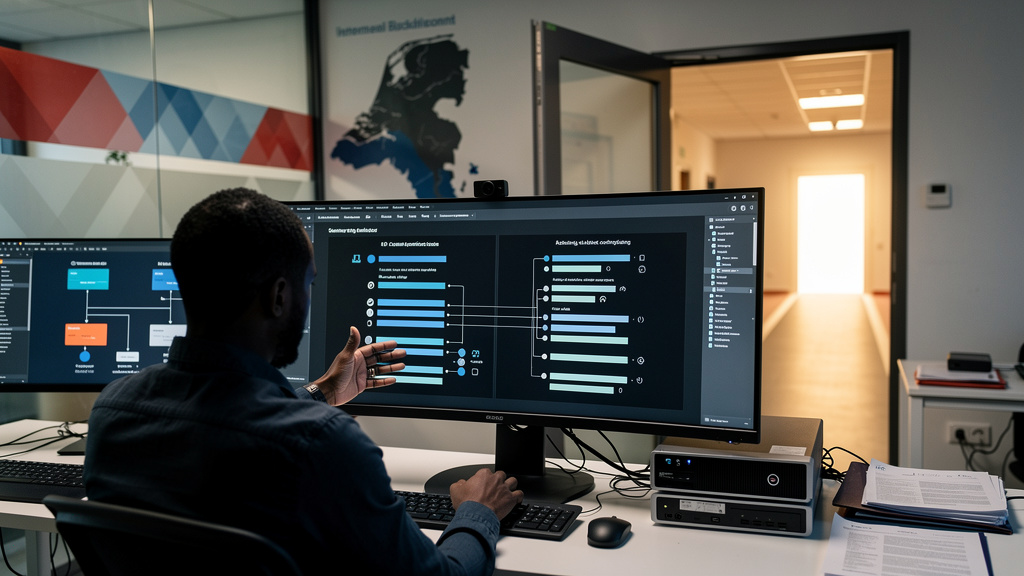
If you have ever rebuilt a workstation from scratch and wondered why the new install behaves subtly different from the old one, you already understand why the Dutch government picked NixOS for its pilot desktop project. Drift is the enemy of auditability. Every package update, every manual configuration change, every service that depends on a system library installed six months ago is a place where two machines that started identical can diverge. NixOS makes drift impossible by treating the entire system as a text file. The Dutch pilot is betting that bet at fifty-thousand-seat scale.
Why a government cares about reproducibility
For a home user, reproducibility is a nice-to-have. You reinstall your laptop, you get most of your setup back, you spend an afternoon finishing the job. For a government, reproducibility is the difference between proving a citizen-facing terminal was patched and hoping it was patched. The audit question is the same one regulators ask pharmaceutical companies: can you show, after the fact, exactly what was on this machine on this date. With a traditional Linux install, the answer is “we think so.” With a NixOS install, the answer is a git commit hash.
The Dutch pilot is a small headcount program with a much larger scope. The working name is DAWO, short for Digitaal Autonome Werkomgeving Overheid, which loosely translates to Digital Autonomous Government Work Environment. The OS, the office suite, the cloud storage, and the management tooling are all meant to live inside the EU. The whole stack has to be auditable, which is why NixOS is in the mix at all.
What NixOS actually gives you
NixOS is unusual among Linux distributions because it does not really install software in the usual sense. You write a configuration file that says what packages you want and how they should be configured. NixOS builds the system from that file. If you want to roll back a change, you boot the previous build. If you want a second machine to match the first, you give it the same configuration file.
For sysadmins used to apt or dnf, the model takes some getting used to. The package manager is not just installing binaries. It is treating the entire filesystem as a content-addressed store (a storage layout where every file is identified by a hash of its contents, so duplicate files are stored only once and any change produces a new file rather than overwriting the old one) where multiple versions of the same library can coexist. The payoff is that an update can never silently break a different package, because each one has its own pinned dependencies.
There are three properties that matter for government use. The first is that you can rebuild an identical machine from a single text file. The second is that every change is a generation, which means every change is reversible in seconds. The third is that you can prove what is on a machine by pointing at the configuration file the machine was built from. None of this is magic. It is just engineering decisions made differently from how Debian or Fedora made them.
Why the announcement matters beyond the four countries
Denmark started the migration wave in 2025. France joined in 2026. Switzerland is running a cantonal-level opt-in. The Netherlands is the fourth, with the NixOS twist. Each country picked a different distro and a different procurement model. The diversity is the interesting part. If all four had picked the same distro, you could dismiss this as one vendor winning a procurement contest. They did not.
What is also missing from the announcements is informative. There is no open-source-versus-proprietary framing. There is no productivity comparison. There is no claim that Linux is cheaper. The argument is entirely about who controls the software and what happens when a foreign power decides to apply pressure. That framing is much harder to argue with than the cost-savings pitch that failed two decades of pilots.
Reporting from Tweakers and statements from Victor Gevers, an Innovation Manager and Security Expert, point at the same two events everyone is pointing at. The first is US sanctions that knocked the International Criminal Court partially offline. The second is Microsoft cutting services for European customers in ways nobody had been warned about. Both moments made the same point: if you depend on software controlled by someone else, you depend on their politics too.
What to watch over the next two years
Four signals tell you whether this trend is real or political theater.
- Whether the Dutch pilot puts a NixOS-based workstation in front of a real citizen-facing employee before the end of 2026. Test accounts do not count.
- Whether any of the four countries publishes its NixOS configuration files in a public repository. Public configuration is the auditable-by-default promise in practice.
- Whether a fifth European government announces its own commitment before the end of 2027. Five governments in three years is a trend.
- Whether existing EU-based Linux distributions see a meaningful jump in government procurement contracts over the next 24 months.
What this means for individual users
You will not see your desktop change because of this. The downstream effects show up in driver work, font work, and accessibility audits paid for under government contracts. That engineering flows into the Linux distributions you already use. Linux Mint, Fedora, Ubuntu, and Debian all benefit, because the work governments pay for is upstream of every consumer distribution.
If you run a small business or a homelab, the question is whether to follow the lead. For most people, the honest answer is no. Windows still runs the games and the random peripherals you already own, and switching costs you days of setup for very little upside. The Dutch government is making this move for political reasons that do not apply to your living room. They have procurement officers and parliament to satisfy. You have a Steam library.
Curious about what sovereign computing feels like in practice? Install a user-friendly Linux like Linux Mint on an old laptop. You will lose a Saturday. You will not lose your data, your privacy, or control over your machine.
Trade-offs
Migrating any large organization off Windows is painful. Drivers for older printers break. Line-of-business apps written for Windows-only runtimes refuse to start. End-user training takes months, not weeks, and the productivity dip during the cutover is real. The Netherlands is running a pilot precisely because every previous attempt to skip the pilot phase failed. Expect this rollout to take years, not quarters.
The second risk is that the pilot loses its reason to exist. Projects justified by a spike in geopolitical tension often get quietly defunded once the tension fades. The current window looks durable, but windows close. If a future administration decides open-source procurement is no longer a strategic priority, DAWO could spend a decade as a demo and never reach a real user.
For readers in the United States, the relevance is mostly indirect. Your distribution upgrades benefit from work governments paid for. Your local Linux meetup gets more interesting tooling. None of that requires you to migrate off Windows at home. For readers in Europe, the choice compounds over a decade. Procurement language your government adopts today shapes what software you actually have access to in 2030.
Bottom line
The Dutch pilot is the first time a major European government has publicly picked an auditable-by-default distribution as the foundation for a desktop rollout. Whether or not DAWO reaches production scale, the engineering work that flows out of it lands in every NixOS-based system on the planet. Watch the procurement language, not the press releases. Procurement language is what compounds.