
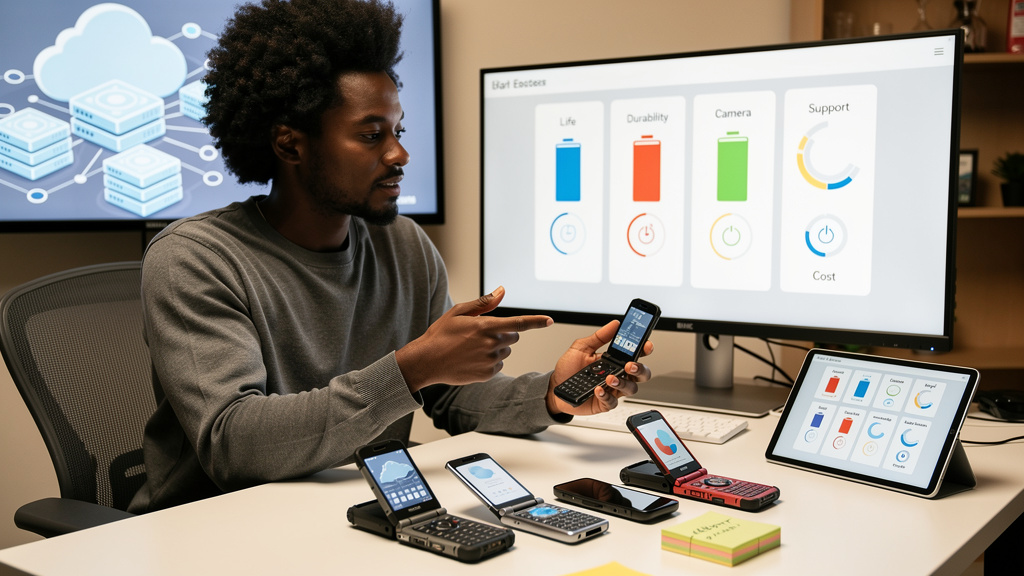
A flip phone asks you to accept compromises that an ordinary slab phone avoids. The crease catches light. The hinge adds weight and another failure point. The cameras usually trail similarly priced flagships. In exchange, you get a large screen that folds into a pocketable square.
That bargain makes brand loyalty a poor buying method. Samsung and Motorola emphasize different parts of it, and neither wins every category. The sensible purchase depends on which compromise you will notice after six months: price, outer-screen usefulness, cameras, update support, repair access, or the feel of the hinge in your hand.
I would ignore the launch-stage claim that one company “owns” flip phones and score the devices against daily behavior instead.
Start with the cover screen because it defines the category
The outer display is not a decorative clock. It determines whether the phone can stay folded for routine tasks. A useful cover screen should let you reply to a message, change music, follow a map, approve a two-factor code, check a calendar, and frame a photograph without opening the device.
Motorola built its recent Razr software around that idea. More regular Android apps can run outside, and the interface treats the display like a small phone rather than a row of widgets. Samsung’s Galaxy Z Flip line has improved, but its path has historically relied more on selected widgets and Good Lock (Samsung’s customization suite) for broader app access.
Test this in a store rather than trusting a compatibility list:
- Open the messaging app you actually use and type a short reply.
- Start walking directions and see how much of the next instruction remains visible.
- Launch the camera, switch lenses, and frame a portrait with the phone folded.
- Open a password manager or authenticator and check whether the interface is usable.
- Dismiss a notification, then confirm you can find it again without unfolding.
A bigger panel does not guarantee a better result. Camera cutouts, keyboard layout, app scaling, and gesture handling matter. The winner is the phone that lets you complete your recurring two-minute tasks while closed.
If you expect to unfold for everything, the cover-screen advantage disappears and the decision shifts toward update policy, camera quality, and price. That is a valid preference, but it raises a harder question: why pay for a clamshell at all if its defining interface stays unused?
Price the phone you can buy, not the one announced on stage
Foldables are unusually sensitive to promotions. Carrier credits, trade-in bonuses, storage upgrades, and holiday discounts can move hundreds of dollars. Comparing list prices alone can point you toward a phone that is more expensive at checkout.
Calculate the two-year ownership cost with the same assumptions for both devices:
- Purchase price after an honest trade-in value, not the maximum advertised credit.
- Sales tax and any required activation or plan upgrade.
- A case and screen-protection plan if you would buy them.
- Insurance or manufacturer care coverage.
- Likely resale value after the period you normally keep a phone.
Watch the financing fine print. A “free” phone spread across 36 monthly credits can cost more than an unlocked discounted phone if it ties you to a pricier plan or makes leaving the carrier expensive. Foldables are improving quickly, so a three-year lock is particularly awkward if the hinge or battery disappoints in year two.
Software support and repair matter more on a moving part
A foldable has more ways to age than a slab phone. The flexible display has a crease and factory-installed protector. The hinge can collect debris. Two halves of the battery must survive heat and charge cycles. A small gap or misalignment that would be cosmetic on another phone can affect how the device closes.
That makes support policy a purchasing feature rather than background paperwork. Samsung has generally offered longer and clearer update commitments across its premium Galaxy range. Motorola’s policies have improved, but they can vary by model and market. Confirm the exact device’s operating-system upgrades and security-update period on the manufacturer’s support page before buying.
Repair access deserves the same scrutiny:
- Is there an authorized walk-in repair location near you?
- Does the care plan cover the inner display and hinge, or only accidental exterior damage?
- What is the deductible for a flexible-screen replacement?
- Will the company ship a replacement first, or leave you without a phone during inspection?
- Does opening the device through an independent shop affect water-resistance claims or warranty coverage?
Samsung’s service network is usually easier to navigate in the United States. Motorola may still be the better value, but the savings should be compared with the cost of mailing away your primary phone after a hinge problem.
Back up before you need service. Repair intake can require a reset, and the hinge gives you one more reason not to keep the only copy of important data on the device.
Cameras expose the cost of folding the hardware
Clamshells devote internal space to a hinge and split battery, so camera hardware rarely matches a conventional flagship at the same price. Daylight photos can look excellent on either brand. The differences appear in motion, low light, zoom, video stabilization, and how consistently the camera chooses a usable exposure.
Samsung tends to have more mature image processing and a predictable camera app. Motorola has narrowed the gap, but model-to-model variation matters. Do not infer the current Razr’s camera from an older review, and do not assume the newest Galaxy Z Flip matches a Galaxy S flagship because both say Samsung on the back.
The folding design also creates a camera advantage: you can use the main cameras for selfies while previewing the frame outside. Test that workflow with skin tones, indoor lighting, and a moving subject. A reviewer photographing buildings at noon may never reveal the blur you see when taking pictures of children or pets in a living room.
My minimum test set is simple:
- A person walking indoors under mixed light.
- Text on a sign at 2x or 3x zoom.
- A backlit face near a window.
- Thirty seconds of handheld video while walking.
- A folded-phone selfie using the main sensor.
Open the full images, not just the phone’s bright display. Look for smeared hair, oversharpened text, skin-tone shifts, and exposure jumps in video. If cameras are a top-two priority, a slab flagship may be the honest answer regardless of which flip wins the comparison.
The hinge and shape must pass a physical test
Specification tables cannot tell you whether the phone feels secure when opening one-handed, whether the sides dig into your palm, or whether the folded thickness fights your pockets. These are devices you manipulate dozens of times a day. The tactile details compound.
At a store, open and close each phone slowly. Stop the display around 90 degrees to see whether it holds position for a tabletop photograph or video call. Check whether the halves align when closed. Run a finger near the hinge and along the inner protector without pressing hard. Then use the phone for ten minutes while standing, not tethered flat to a display table if staff can safely release it.
Pay attention to these less obvious details:
- The location and reach of the fingerprint sensor.
- Whether a case makes the volume and power buttons awkward.
- How much the camera bump rocks on a table while open.
- Whether dust collects in the gap when folded.
- How visible the crease is under overhead light while reading.
Water resistance is helpful, but it does not mean dust-proof. Sand and fine debris remain poor companions for hinges. If your work involves construction, landscaping, workshops, or beaches, the mechanical form may be a mismatch no matter how good the software is.
Choose by buyer type, then compare the exact offers
I would frame the Samsung-versus-Motorola decision as a set of priorities rather than a universal ranking.
Choose the Galaxy Z Flip model when longer software support, established repair options, Samsung services, predictable cameras, or a strong trade-in offer carry the most weight. Existing Galaxy Watch, Buds, SmartThings, or DeX habits may also reduce switching friction, though clamshell support for desktop features should be checked on the exact model.
Choose a Razr when the outer display is central to how you plan to use the phone, the direct price is meaningfully lower, or Motorola’s shape and interface feel better in hand. A standard Razr can be a strong entry point when the premium model’s processor or camera improvements do not change your daily tasks.
Skip both when your priorities are maximum camera quality, multi-day battery life, ruggedness, easy independent repair, or the lowest cost over several years. A conventional phone usually handles those needs better. Folding is a feature you pay for in both money and compromises.
Trade-offs
Samsung may cost more without a promotion, and its outer-screen restrictions can frustrate people who want ordinary apps while folded. Motorola’s broader cover-screen approach can feel more natural, while its smaller repair network may add risk.
Both brands ask you to tolerate a crease, a more fragile inner surface, modest battery capacity, and camera compromises relative to similarly priced slab phones. Insurance reduces financial risk but raises ownership cost and still leaves the inconvenience of repair.
Long-term hinge behavior is hard to judge at launch. Read warranty terms, inspect owner reports after several months, and avoid treating either enthusiastic praise or isolated breakage as the whole dataset.
The greatest trade-off is behavioral. A flip phone can reduce casual scrolling by making the cover display useful for short tasks, or it can add an opening gesture before the same habits. Hardware nudges behavior; it does not rewrite it.
What I would tell past me
I once compared foldables as if the processor and camera count would identify a clear winner. The details that mattered later were the price after trade-in, the cover-screen keyboard, and whether local repair was available.
- Test the closed-phone workflow first. If it cannot complete your common quick tasks, the category’s main advantage is wasted.
- Compare checkout totals on the same day. Foldable promotions make old price comparisons unreliable.
- Read the inner-display coverage line by line. “Device protection” can hide a large deductible or narrow hinge exclusions.
- Photograph something that moves indoors. Static daylight samples flatter almost every modern phone.
- Let comfort break a tie. A hinge and shape you enjoy handling will matter more than a benchmark gap you never feel.
There is no permanent crown for flip phones. There is only the exact Galaxy Z Flip, exact Razr, exact price, and exact set of compromises in front of you.