
Why Vinyl Still Wins the Collection Game (And Where CDs Actually Make Sense)
Here is a thing nobody expected: vinyl records are outselling CDs in 2026, and the gap is widening. Not just among nostalgic boomers reliving their youth. Gen Z, the generation that grew up with Spotify and Apple Music, has decided that holding a physical black disc matters more than infinite digital access. CDs are quietly staging their own comeback too, driven by affordability and a different kind of nostalgia. If you are thinking about starting a physical music collection this year, you need to know which format actually delivers the experience you are after, and which one is going to sit on a shelf gathering dust.
I will save you the suspense. For pure collecting joy, vinyl wins. That does not mean CDs are pointless. They solve real problems vinyl cannot touch. The question is what you value more: the hunt and the ritual, or the practicality and the price. The two formats are not really competing for the same audience, and pretending they are is how the music industry got into the mess it is in.
The numbers nobody wants to talk about
Vinyl outsold CDs in the United States starting in 2020, and the gap has been growing every year since. According to the RIAA’s 2025 mid-year report, vinyl generated $537 million in revenue during the first half of the year while CDs brought in $247 million. The vinyl number is up 17 percent year-over-year. The CD number is up 4 percent. Both formats are growing, but vinyl is growing faster, and the collector demographic skews younger than the industry expected.
- Vinyl has been outselling CDs in the U.S. since 2020. The crossover happened while everyone was busy debating whether physical media was dead.
- Gen Z is driving vinyl growth. Roughly 40 percent of new vinyl buyers in 2024 were under 30, according to a MRC Data survey. The format is not a nostalgia play. It is a deliberate choice by listeners who have never known a world without Spotify.
- CDs are also growing, just slower. The format is benefiting from the same anti-streaming sentiment, but at a lower price point and with less cultural cachet.
- Streaming is still 80 percent of music revenue. The “vinyl revival” narrative is real, but in absolute terms it is a small slice of how people listen. The format war is happening in a niche that the streaming services are happy to ignore.
The interesting story is not the dollar amounts. It is the demographics. The people buying vinyl today are not the people who owned turntables in 1985. They are listeners who grew up with infinite choice and decided that choice was not actually what they wanted. That is a much weirder cultural signal than the sales numbers suggest, and it is worth thinking about what it means for the attention economy in general.
The ritual is the whole point
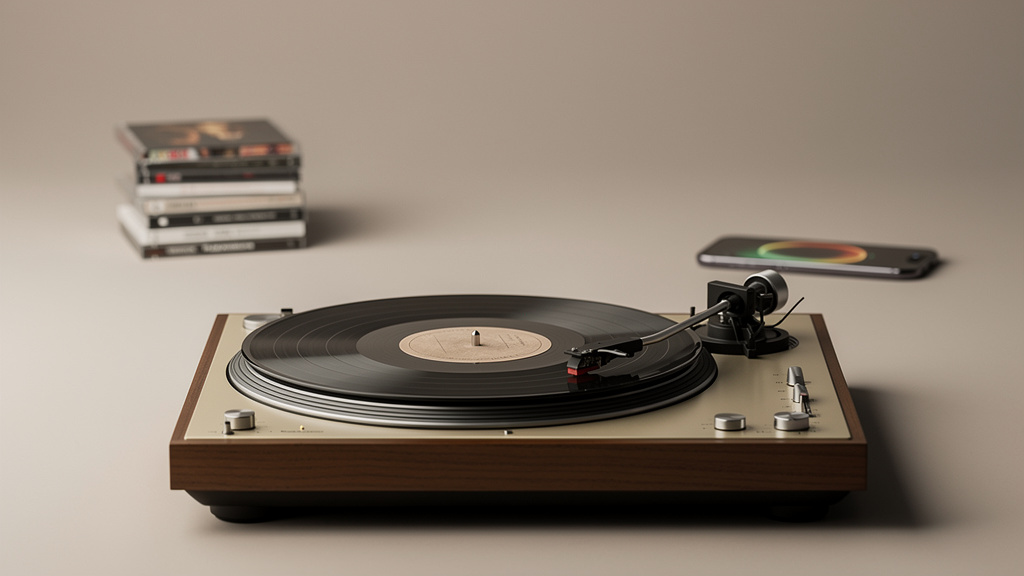
Playing a vinyl record is not fast. You flip through your collection to find the right album. You slide the disc carefully from its sleeve. You place it on the platter, run a brush over the surface to clear dust, lower the needle, and finally sit back as the first crackles emerge. This is not inefficient. It is intentional. The slowness is the feature.
That deliberate process changes how you listen. You are not background streaming while doing dishes. You are actively engaging with the music. The album becomes an event, not a soundtrack. The large format artwork matters. Holding a 12-inch sleeve with detailed liner notes and photos feels completely different from squinting at a CD booklet or scrolling through digital metadata on your phone. The format itself enforces attention, and attention is the thing that streaming has been training us out of for fifteen years.
- Dropping the needle forces you to stop multitasking. You cannot queue up a record and then scroll your phone. The format requires presence.
- Album art at 12 inches becomes part of the experience. The square format that was designed for vinyl is the only medium where album art actually gets the space it was designed for.
- Flipping the record at the halfway point keeps you connected to the full album. Streaming has trained us to skip tracks. Vinyl physically prevents that without making it feel like a restriction.
- The physical hunt in record stores adds adventure that online shopping cannot replicate. Digging through crates for an out-of-print pressing is its own reward, even when you come home empty-handed.
The format is essentially a behavioral commitment device. It makes you slow down, pay attention, and finish what you started. In a culture that has spent two decades optimizing for the opposite, that is not nothing. The vinyl revival is not really about music. It is about reclaiming a way of paying attention that streaming eroded.
CDs have real advantages vinyl cannot match
Let me be straight about this. CDs are cheaper, more portable, and objectively more convenient. You can buy a used CD for a few dollars at thrift stores, garage sales, or online marketplaces. New CDs cost less than half what new vinyl costs. If you want to build a substantial collection without draining your bank account, CDs are the obvious choice. They also take up less space. A CD collection fits on a single shelf. A vinyl collection needs dedicated storage, proper shelving, and climate consideration. Heat and humidity warp records. CDs are more forgiving. Plus, you can rip CDs to digital files for portable listening, something vinyl requires extra equipment and time to accomplish.
- Used CDs often cost $1 to $5 compared to $15 to $40 for the same album on vinyl. The same money that buys you three records can build out a CD collection of fifty albums.
- CDs are portable in a way vinyl is not. A portable CD player and a stack of discs is a perfectly reasonable travel setup. A portable turntable is a niche product that delivers noticeably worse sound.
- CD sound quality is technically superior to vinyl. The dynamic range (the difference between the quietest and loudest sounds a format can reproduce) of a well-mastered CD exceeds what any vinyl pressing can deliver. Most listeners cannot hear the difference, and the surface noise on vinyl is a feature rather than a bug for many collectors, but the engineering reality is what it is.
- CDs hold up to physical handling better. A scratched CD often still plays. A scratched vinyl will skip, pop, and eventually become unplayable. The format is more forgiving for the way most people actually treat their media.
CDs are the practical choice. They are the format for people who want the music without the ceremony, who want to build a large collection without the storage overhead, and who want the option of digital convenience without surrendering the physical object entirely. The CD is not dead, and the demographic for CD buyers tends to be listeners who want a substantial library they can actually use, not a curated shrine.
Why the streaming backlash is real, even if it is small
The vinyl revival and the CD resurgence are both symptoms of the same cultural fatigue. Streaming services promised infinite choice at a low monthly price, and they delivered on the promise. The cost was attention, and the cost was ownership. When you stream an album, you do not own it. The service can revoke access, change the mix, or remove the record entirely. The music is not yours in any meaningful sense. The format that lets you hold the album, see the artwork, and play it on your own equipment, has become a quiet act of resistance against the rental model of media consumption.
That framing is a little overheated for what is, in practice, a hobby. Most vinyl buyers also stream. The two formats are not mutually exclusive. But the fact that a generation that has never known a world without Spotify is choosing to spend $30 on a single record says something about the limits of the streaming model. The convenience was always going to plateau. The novelty of having every album ever recorded in your pocket wore off faster than the industry expected, and the listeners who stayed are the ones who wanted the music to feel like it mattered again. The format change is not the point. The attention change is.
Trade-offs
Neither format is the right answer for every listener. Vinyl is expensive, takes up space, and requires a meaningful upfront investment in a turntable, a phono preamp (a small amplifier that boosts the very low signal from a turntable cartridge up to a level your main amplifier can use), and a decent pair of speakers. A reasonable starter setup runs $400 to $600 before you have bought a single record. CDs are cheaper, more portable, and easier to rip to digital, but they lack the cultural and aesthetic weight that makes vinyl feel like a hobby rather than a collection.
Here is how I would weigh the choice.
- If you want the ritual and the aesthetic, buy vinyl. Budget for a real turntable, accept that you will be curating rather than collecting, and be prepared to pay $25 to $40 per album.
- If you want a large library on a budget, buy CDs. Used CDs are an underpriced resource, and the format is more forgiving for casual listening.
- If you want both, you already know. The audiophile path is to own the vinyl for the ritual and rip the CD for the car. The two formats are not really in conflict.
- If you only stream, ask yourself why. The answer will tell you whether the format change is worth it or whether you are just tired of the monthly bill.
The format war is not really a war. It is a niche within a niche, and the streaming services are happy to let vinyl and CD buyers subsidize the convenience tier for everyone else. The real choice is whether you want music to be a thing you own or a thing you rent. Both answers are valid. The format is downstream of the question.
What I would tell past me
If I could send a message back to the version of me who sold my CD collection in 2009 because “everything is on Spotify now,” I would say four things.
- The collection was not the mistake. Letting go of the physical object in exchange for the convenience was the mistake. The convenience has plateaued. The collection would have only gotten more interesting.
- Buy a real turntable on day one. Do not waste a year with a cheap plastic one. The sound difference is real, and the cheap one will collect dust.
- Used CDs are an underpriced resource. The thrift store bin is the last place in retail where you can find genuine surprise. The Internet killed everything else.
- Streaming is fine for discovery. Own the music that matters. Rent the music you are just sampling. The two uses are not in conflict.
The bottom line is this. Vinyl and CDs are both having a moment, and the moment is real, even if the absolute numbers are small. The listeners driving both trends are not the nostalgics. They are the people who grew up with streaming and decided it was not enough. The format change is a proxy for the attention change, and the attention change is the only thing that has ever made music feel like it mattered.