
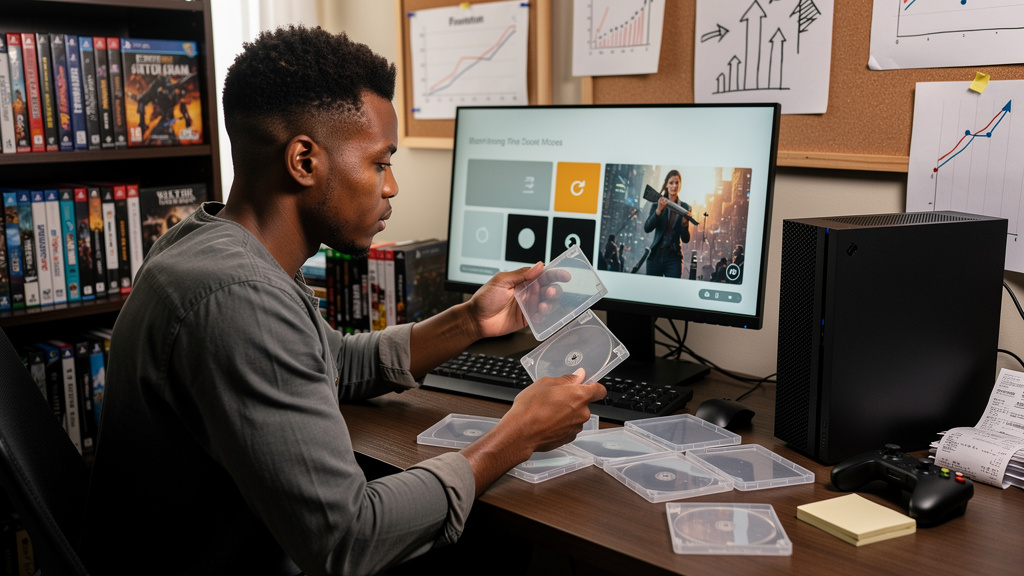
The CEO of Take-Two (Strauss Zelnick) is telling anyone who will listen that GTA 6 going all-digital makes sense for consumers. The argument is that the publisher’s business is already “well over 90% digitally distributed,” that big games do not really fit on a disc anymore, and that online registration requirements make the choice between disc and download moot anyway. He is not wrong about the business being mostly digital. He is also not being honest about which side of the trade that argument is coming from, and the missing piece is the one that matters most to players: a physical disc is the only thing that lets you resell, lend, or trade a copy of a game you are done with. GTA 6 will not have that option at launch.
This is the part that gets glossed over when executives talk about “convenience,” and it is the part that ought to matter to anyone who paid full price for a game and expects to recover some of that money when they are finished.
What Zelnick actually said, and what he left out
The full quote from Zelnick, surfaced via IGN and republished in Windows Central’s coverage, runs roughly like this. Take-Two’s business is already 90% digital. For certain big games, discs do not really make sense for the consumer. Most games require online registration to play anyway, so once you are connected, downloading versus buying a disc is functionally identical. It is all the same and more convenient.
That is the case as presented. The case as lived by the people buying the game is different. To play GTA 6 at launch you need a Microsoft or Sony account, a publisher account for the studio behind GTA, almost certainly a subscription for online play, and the bandwidth to download a large game file. None of those requirements are new. All of them are individually reasonable. Stacked together, they describe a world in which the publisher owns the distribution channel, the storefront, the account, the matchmaking, and the resale rights on the second copy of the game that does not exist because there is no disc to put it on.
That is the structural change. The disc was not just a delivery mechanism. It was the only part of the consumer relationship with a game that could be transferred. Once it is gone, no part of the transaction is.
Why the disc-versus-download framing misses the actual change
The most-cited reason that GTA 6 cannot fit on a disc is that the file is too big. That is partly true. GTA V shipped on two discs on Xbox 360 because the single-disc capacity was too small. Red Dead Redemption 2 did the same on Xbox One. GTA 6 is larger still, and a Blu-ray disc cuts it close.
Two things make that argument weaker than it sounds. First, the relevant comparison is not “can it fit” but “would Take-Two accept the small extra cost of putting it on two discs if discs were still part of the model.” Two-disc shipping is not a novel problem. Game publishers solved it for an entire console generation. Second, the file size keeps growing because publishers keep filling it with online services, microtransaction pipelines, and versioned installs that could be slimmed if there were an incentive to slim them. The size of the file is downstream of the design choices, not the other way around.
The deeper point is that the missing disc is not a logistical casualty. It is a deliberate choice. Physical media in the music industry got smaller and cheaper as downloads took over, then disappeared entirely. Physical games are following the same curve. The question for players is whether the trade-off that was made (convenience in exchange for ownership) is one they would have agreed to if anyone had asked them.
What you actually lose when there is no disc
The list below is what a physical copy used to do, in roughly the order most players would notice if it disappeared.
- Resale. This is the obvious one and the one Zelnick left out. A used copy of a popular game can recover a meaningful share of the original price on the secondary market. GTA V has been resold many times since launch, and that activity is now ending for the publisher’s biggest release.
- Lending and trading. A disc can be passed to a friend, traded at a local game store, or handed down to a younger sibling. A digital license can do none of those things without explicit publisher support, which publishers have not built for general consumers.
- Long-term archival. A physical disc in good condition can sit on a shelf for decades and still install. Digital storefronts can pull a game at any time, and storefronts themselves can disappear. A digital purchase is only as durable as the storefront that hosts it. A sealed copy of GTA V is whatever the owner keeps it in.
- Regional availability. Digital stores vary by region, and the publisher can revoke regional access at any time. A physical disc is a single SKU (stock keeping unit, a distinct product code) that plays the same way in any compatible console.
- Price transparency. The secondary market is a real price discovery mechanism for games that are otherwise sold at the publisher’s list price forever. Used copies are how most players experienced the back catalog at a reasonable price. Without the secondary market, the publisher sets the only price.
None of those were on Zelnick’s list of considerations when he made the case for digital-only. That is the structural critique. It is not about whether digital is convenient. It is about whether the convenience is the only thing the publisher is willing to optimize for.
What Zelnick’s vinyl analogy actually means
The comparison Zelnick offered was that physical games will still exist the way vinyl records still exist. As a passing analogy, that is fine. As a serious comparison, it understates the change.
Vinyl survived as a niche because the music rights holders had no interest in killing it. Streaming services pay better per-stream than physical sales, and the catalog stayed available on the platform that pays them best. Vinyl is a niche product for collectors and audiophiles. It is not a structural component of how most people listen to music.
Physical games are headed in the same direction. A small collector market will persist for as long as disc pressings are made. New releases will go the way of new music: digital only at launch, with the occasional specialty run for the enthusiast crowd. The difference is that the music industry never had a strong second-hand market to begin with, whereas the gaming industry’s used-game market has been a meaningful part of how players experience the back catalog. That secondary market is what gets cut.
Trade-offs
Going digital-only is not a free decision for the publisher, and pretending it is would be a mistake. The trade-offs are real and worth being specific about.
- Take-Two’s distribution costs go down. No pressing, no shipping, no inventory risk on unsold disc stock. That is a real savings, and it does not all flow to the consumer. Most of it flows to the publisher’s gross margin (the percentage of revenue left after the direct cost of goods sold).
- The publisher loses the disintermediation (the ability of third parties to participate in the transaction without the publisher’s permission) that the used market provided. That is the whole point of the change for the publisher, and it is the source of the gain.
- Players lose the resale value of their purchase. The share of the purchase price that used copies would have recovered on the secondary market is now a permanent transfer to the publisher.
- Players gain a small amount of convenience. No trip to the store, no disc to swap, no risk of a scratched disc refusing to install. The convenience is real, but it is smaller than the resale loss.
- The publisher’s catalog control tightens. They can pull a game from the storefront at any time, and players have no recourse beyond the publisher’s customer service. That is the structural change, and it is not reversible on the consumer side once the discs stop being pressed.
If the convenience-to-resale ratio matters to you, and you tend to play games to completion and resell them within a year or two, the math now works against you. If you tend to keep games indefinitely and you play a small library deeply, the change matters less. There is no general answer. The general answer is that the publisher has chosen to optimize for the second group, and the first group is not being compensated for the loss.
Bottom line
GTA 6 going all-digital is a business decision, and the case being made for it is a public-relations exercise. The reasons given (file size, online registration, convenience) are all real, and none of them are the actual reason. The actual reason is that the publisher wants the used market gone, and removing the disc is the cleanest way to remove it.
Players who care about the resale value of their purchase have a few options. They can lobby for digital resale rights, which is a regulatory fight that has been going on for a decade and that publishers have consistently resisted. They can buy the collector’s edition if one exists, since the disc included with that edition often retains some resale value. They can stop buying new and wait for a sale on the digital storefront, which is the only price discovery that is still possible.
Or, the cleanest answer, they can vote with their wallet on whether this is the relationship they want with the games they buy. The publisher has made the choice. The publisher has not made the case.