
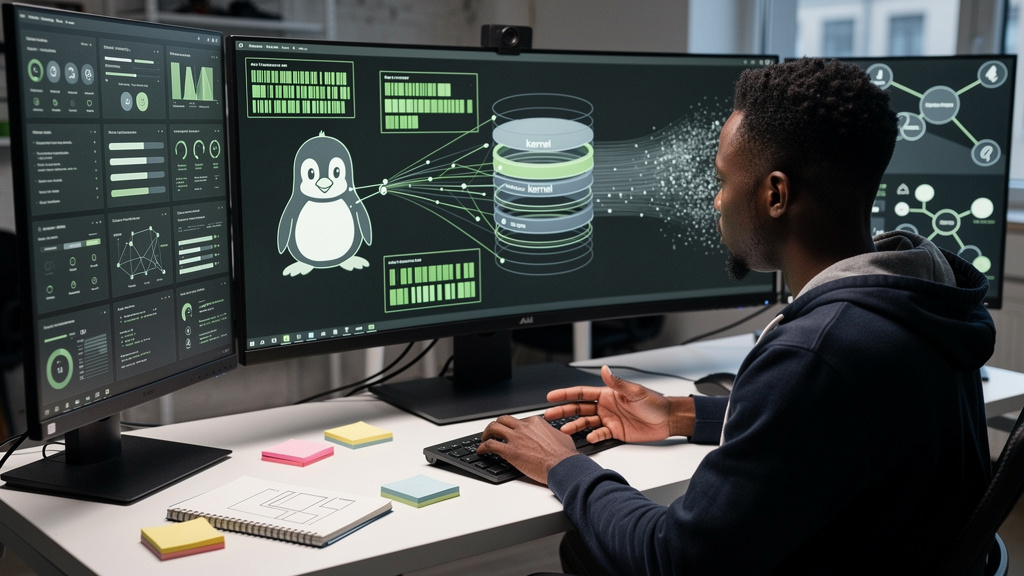
I keep an eye on Apple Silicon Linux because the hardware is genuinely hard to support. Most projects in that space promise to stick around and build a community. Gravity Linux promises the opposite. Its public roadmap is to upstream all of its kernel work into mainline Linux (the shared upstream kernel that every distribution pulls from) and then stop shipping its own distribution. I find that framing interesting, because the practical effect on the person who installs it is bigger than the announcement suggests.
The team is two developers, Cody Ho and Niklas Sheth, who split off from Asahi Linux (the longest-running Apple-on-Linux effort, started around 2020) over how AI-assisted commits should be credited. Asahi keeps AI contributions tightly bounded. Gravity publishes an Assisted-By tag on every AI-touched commit so both the human author and the tool appear in the commit log. That is a real policy choice and you can argue it either way, but it is not hidden.
Day one on the M4 Mac mini
The alpha targets the M4 Mac mini. Only that machine. Not the whole M4 lineup, not M3, not M2. The narrow scope is on purpose, and it shows in what already works at first boot. The display controller and the GPU work without extra setup. OpenGL ES 3.0 (a 3D graphics standard for mobile-class hardware) and OpenGL 3.3 are both passing, which means hardware-accelerated graphics is on by default. HDMI works. For a brand-new Apple Silicon alpha, that starting point is a lot stronger than I expected.
The honest list of what is missing:
- Closing the lid does not put the machine to sleep. Suspend is broken.
- There is no driver for Thunderbolt or USB4. They will not show up as devices.
- USB-C display output is unsupported. If you wanted to dock your Mac mini over USB-C to a monitor, plug into HDMI instead.
- Reboot and shutdown are flaky. The team suggests holding the power button when the system does not respond.
- Speaker volume is limited to a conservative level on purpose. Annoying if you use the mini as a media box, sensible for a first public test.
This is what a real alpha looks like. Some pieces work, some pieces obviously do not, and the project is not pretending otherwise.
- GPU, display pipeline, OpenGL ES 3.0, and OpenGL 3.3 all work at first boot
- HDMI works, USB-C display output does not
- Suspend, Thunderbolt, USB4, reboot, and shutdown are unstable or absent
- Speaker volume capped for hardware safety
Read the install script first
I have to flag the install path because the default is a curl | sh one-liner (a single command that downloads a script and immediately runs it as root on your machine). It is the fastest possible way to install something. It is also the pattern that has bitten people in the past, and on a brand-new project from a two-person team with no community review of the install script, it is a real trade-off you should know about.
The minimum version of this I would actually run looks like this:
- Save the script to disk first instead of piping it. Most curl versions let you do
curl -O <url>orcurl <url> > script.sh. - Read every line. The script runs as root, so the failure modes are real and the trust requirement is total.
- Run it manually after you have read it.
The project itself describes the alpha as developer-focused and unfit for daily use, with no promised upgrade path to the next release. Plan on a clean reinstall later. Treat this like testing a pre-release kernel, not picking a new operating system to live in.
M5 is a problem you cannot fix from the Linux side
The M5 Pro and M5 Max currently fail to wake up their secondary CPU cores when booted into macOS 27.0 Beta 5. That is a firmware bug on Apple’s side. Linux cannot patch around it. Apple is reportedly aware of the issue and has not committed to a fix, which means M5 support in Gravity is on hold until Apple decides to do something. If you are shopping for a Mac with the intent to run Linux on it, that is information you need before you buy, not after.
The future target list does include more than the M4 Mac mini. MacBook Neo and the rest of the M4 family are on the roadmap, and new contributors are picking up other models. The current alpha is narrow on purpose. The wider plan is real.
- M5 Pro and M5 Max are blocked by a firmware bug Apple has not fixed
- No public ETA for the fix
- MacBook Neo and other M4 family machines are on the roadmap
- M5 support is paused, not abandoned
- Buy M4 if Linux matters; skip M5 for now
The temporary distribution is not a contradiction
Open-source mission statements tend to be vague. This one has teeth, though. The deliverable is the kernel work, not the distribution. Gravity exists so that its display, GPU, and power code can land in mainline Linux over time. The distribution is a vehicle for shipping that code while the upstream review process grinds along. Once enough of it lands, the distribution has done its job.
That framing matters for users, because it explains why the project is comfortable advertising its own planned end. Most distributions promise longevity because they want a community to keep them alive. Gravity is comfortable naming its own expiration because longevity is not the goal. If you never run Gravity Linux directly, you may still benefit from it the next time you install Fedora or Ubuntu on Apple Silicon hardware.
It is also why I would not put the alpha on a machine I depend on. There is no promised upgrade path to the beta, several headline features are missing, and the team is being open about all of that. Match your expectations to what is shipping.
- The goal is kernel upstream contributions, not a permanent distro
- Non-users may benefit when the patches reach mainline Linux
- The alpha is a test bed, not a daily driver
- A full reinstall between releases is expected
- Frame the project as kernel testing, not OS adoption
Trade-offs
Gravity Linux is not a free upgrade over your current setup. The cost of admission is reading the install script yourself and accepting a clean reinstall between releases. That is a real ask, and the reason most people should not run it on a machine they rely on.
The supported hardware list is also small on purpose. The alpha covers only the M4 Mac mini. If you have any other Apple Silicon Mac, you are waiting. If you have an M5, you are waiting on Apple. Anyone whose daily machine is not an M4 Mac mini is the wrong audience for the alpha right now.
The longevity story is the unusual part. Most distributions sell you a long-term roadmap. Gravity sells you a planned exit. If you want a distribution you can install and forget about for five years, Fedora or Ubuntu is the right answer. If you want to help get Apple Silicon support into the mainline kernel, Gravity is where the work is happening this year.
If you have a spare M4 Mac mini and a tolerance for breaking changes, the alpha is worth a look. If you need a stable daily driver, wait.
What I would tell past me
- Read every line of a curl install script before you run it, especially on a new project. Trust is earned, not given.
- Buy the M4 over the M5 if you care about Linux on Apple Silicon. The M5 firmware issue is going to take a while.
- A distribution that plans to disappear is fine if the kernel patches are the real deliverable. Plan around that and Gravity Linux stops looking strange.