
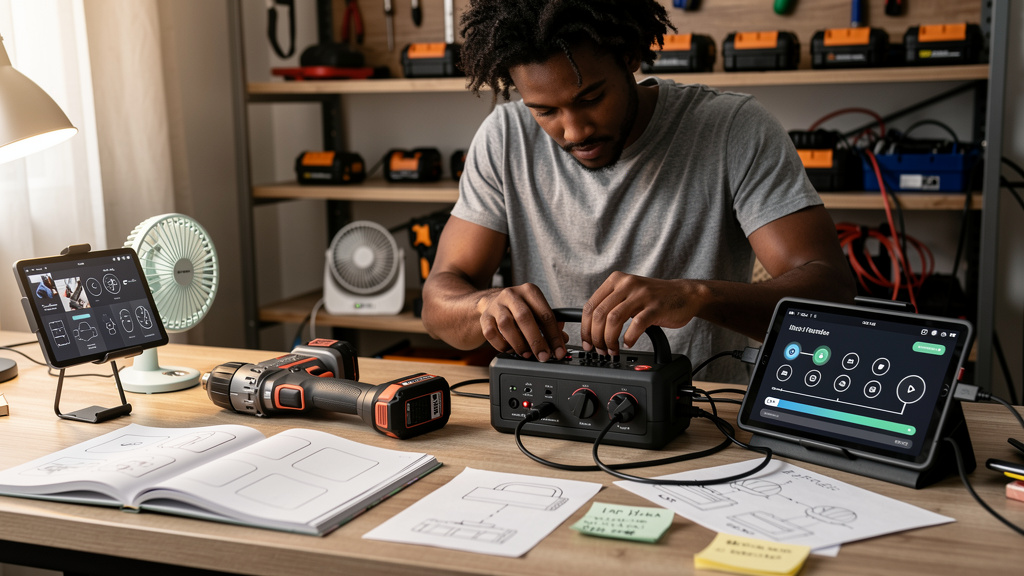
I own two Ryobi packs that barely earn their keep. One is a 6Ah, the other a 4Ah, both bought in different years. The drill they power sees maybe one weekend a month in our shop, which leaves roughly 180Wh of stored energy sitting on a shelf at any given time.
After two hurricane seasons in East Texas, that stockpile stopped feeling like clutter and started feeling like a small power reserve I had already paid for. Here is what I have learned about actually putting drill batteries to work during an outage, and the parts of the story the marketing skips.
The three accessories that handle almost everything
You do not need a closet full of adapters. Three cover roughly 90 percent of what a typical home wants to keep running during an outage. A USB-C adapter handles phones, tablets, and small electronics. A clip-on inverter puts a real AC outlet on the battery for anything that uses a wall wart. A 12V step-down adapter powers devices that already take DC through a barrel jack, which includes most cable modems and a lot of routers.
That third one is the most efficient. Avoiding the AC round-trip means less energy lost as heat, so a device on step-down gets noticeably more runtime per watt-hour than the same device running through an inverter.
The runtime math trips people up. Volts times amp-hours gives you stored watt-hours. A 6.0Ah pack at the 18V most cordless tools use holds about 108Wh on paper. Conversion losses through a clip-on inverter take 10 to 15 percent off that. So a battery delivering 30W is closer to three hours of actual runtime, not the four the simple division suggests. The number you can actually use is always lower than the number on the side of the pack.
If you only buy one adapter, the clip-on inverter is the right call. It works with anything you already own that has a wall plug, and there is no compatibility gamble. If you only buy two, add a step-down for the modem, because keeping your network alive during a blackout pays for itself the first time you need the outage map.
The internet is the easy four hours
A phone with no Wi-Fi falls back to cellular for every text, every weather alert, every refresh of the outage map. That works for about an hour and gets expensive fast. Keeping the home network running is the single highest-value thing a tool battery can do during a short blackout.
A typical ISP-issued modem and Wi-Fi router pull somewhere around 15 to 25W combined. That is a comfortable load for any 150W inverter. A full 6Ah pack will run both for about four hours once conversion losses are counted. Switch the modem to a 12V step-down through its barrel jack and the runtime stretches further.
My home network is the exception that proves the rule. The UniFi gateway in the basement hands power to a PoE switch (Power over Ethernet: the switch itself powers the access points through the network cables) and four ceiling APs, and the whole chain likely draws more than a clip-on inverter can feed. The router your ISP gives you is a much lighter load. If your gear is closer to mine than to a stock ISP box, do the wattage math before you trust a single 5Ah pack.
The habits that keep this setup safe are not exotic:
- Match voltage, polarity, and plug size to the label on the device’s power brick before plugging in
- Polarity on barrel jacks is not standardized, and a reversed cable can fry the device at the other end
- Clip-on inverters run hot under sustained load, so give them airflow
- Do not stack adapters to chase more wattage, because every conversion step dumps more energy as heat
For laptops, skip the battery’s USB-C port
USB-C on a power-bank-style adapter seems like the obvious move for a laptop, and it usually is not. Most tool-battery USB ports cannot sustain the wattage a modern laptop wants. A 65W laptop will negotiate down to 15W through the pack’s port, which means slow drain instead of charging. A clip-on inverter feeding your existing laptop brick is the right answer. There are several 150W inverters on the market that put a real AC outlet on the battery, and your 90W or 100W USB-C wall charger does what it was built to do.
Realistic runtime from a fully topped 5Ah pack is around 90 minutes of full-power laptop work through the inverter. Drop the screen brightness and the workload and that doubles. Heavy compile jobs and video calls pull noticeably more than light web work.
Phone and tablet charging, the cheapest add-on
A pack-side USB-C adapter is the cheapest piece of gear in the whole setup, and usually the most reliable. A single 5Ah pack can recharge a typical phone five or six times before it gives up, and the same pack will refill a tablet twice. If you have never used a tool battery for anything but a drill, this is the place to start.
Two failure modes show up often. Cheap adapters sometimes negotiate a slow charge when the device asked for fast charging. Some adapters overstate their wattage on the box and then shut off under load. Buy from a brand you already trust, and test with a stopwatch before you really need it.
Comfort devices, where the swap is actually meaningful
For an outage, this is the swap that improves daily life. Phones can wait. The fridge holds for hours if you do not open it. A bright room to read in, cook in, and find the candles in matters a lot. If you own a cordless LED work light, you already own half of this setup, because the lights were designed to run on the same packs. A standard 18V work light pulls in the 10 to 20W range, which means a single 5Ah pack will keep one lit for five to ten hours.
A 12V clip fan is a similar story. It pulls 10 to 30W depending on speed. Through an inverter, a 5Ah pack keeps one blowing for three to eight hours. In a Texas summer with no grid power, that is the difference between sleeping through an outage and not.
Trade-offs
Tool batteries were not built for sustained low-drain delivery. The cells inside are tuned for the high bursts a drill or impact driver demands, so the runtime you get powering a router for hours is shorter than what a purpose-built station would deliver from the same stored watt-hours. Anyone who tells you a 108Wh Ryobi pack is equivalent to a 108Wh Bluetti has not measured both on the same workload.
Adapter quality varies more than the marketing suggests. I have burned through one USB-C adapter that over-promised on wattage and shut itself off under load, and another that negotiated so poorly that my phone reported a trickle. Cheap adapters cut corners on the chips that handle the handshake with the device.
There is also a real safety floor. Polarity matters, ventilation matters, and daisy-chaining adapters does not work. None of it is exotic, but it is the kind of thing people skip because the cables look interchangeable.
Setting this up takes a Sunday afternoon. Mount the inverter holder somewhere dry, label both adapters, top off every pack, and run each one flat on the device you care about most with a stopwatch so you know the actual runtime. About twenty minutes per pack, and you walk away with a number you can quote instead of a guess.
For most people with a drawer of packs they barely use, this is the obvious next step. If you are buying batteries for the first time, a small purpose-built station is the cleaner choice.
What I would tell past me
Three things, addressed to the version of me that ran out of phone battery during the 2023 ice storm and could not check the outage map.
- Pick one adapter and one device before buying a second of either. Clip-on inverter plus the modem is the entry point. Everything else stacks on top of that.
- Test every pack flat with a stopwatch before the first storm. The number on the side is stored energy, not delivered energy. The delivered number is lower and depends on the device at the other end.
- Label the polarity on every barrel-jack adapter you build. A reversed barrel jack is a paperweight on the other end, and the warning on the cable is in tiny print.