
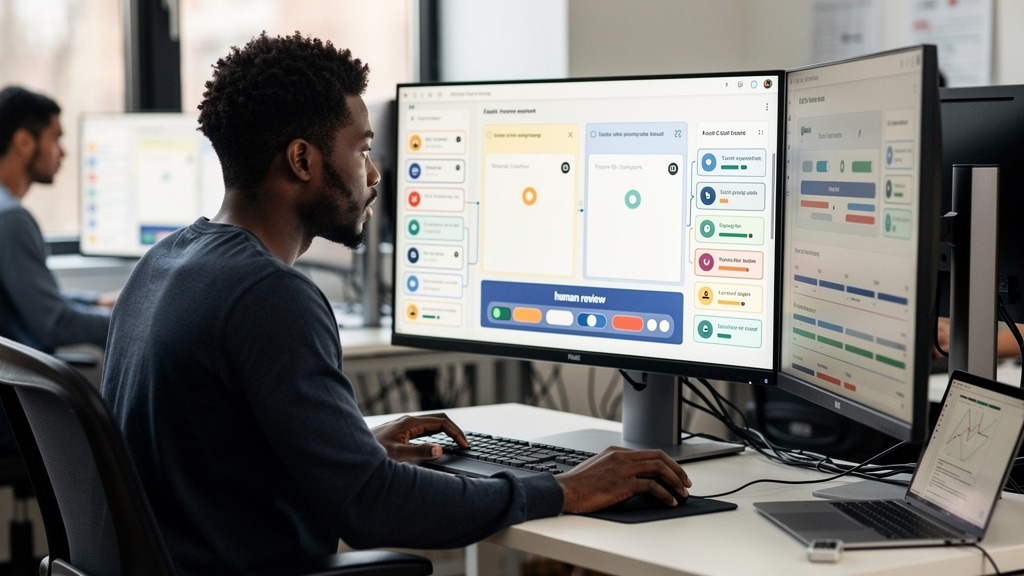
Generative user interfaces have been promised for two years and shipped for none. Every demo dies the same way: the latency is unusable past the first click, the layout breaks consistency by the second session, and the audit story collapses when a regulated team asks a basic question. Runway just put a name on its attempt: Solaris. The announcement is not the interesting part. The interesting part is that Runway has production generative infrastructure that previous attempts did not have, which changes the engineering odds for this category.
The teams that have tried generative interfaces in the last two years built them as side projects. Their core competency was a chat product, or a static design tool, or an experimental lab with no shipped model to a paying user base. Runway has shipped prompt-first video generation at scale. That is not a small advantage. It is the difference between a team that can debug model inference problems when they show up and a team that has to learn on the user’s dime.
The three failure modes that killed previous attempts
I want to be precise about why previous attempts died, because the failure modes are well documented and Runway will hit at least one of them within six months of launch. Knowing the failure modes is the prerequisite for evaluating the announcement.
Latency is the first failure mode. A static page renders in fifty milliseconds. A generated page renders in five hundred to two thousand milliseconds on the first call, lower on subsequent calls if the model has cached the response. Users do not care why. They care that the second click feels responsive. The teams that ship successfully will invest heavily in inference caching, request precompute, and pattern matching for common workflows. The teams that ship unsuccessfully will assume the model latency is fixed and ship a product that feels broken from day one.
Constraint specification is the second failure mode. Generated interfaces need explicit guardrails. Which components can move. Which components are pinned. Which actions require confirmation. Which actions are forbidden entirely. The teams that ship successfully write this spec before they write the first prompt. The teams that ship unsuccessfully let the model invent the constraints and spend the next six months debugging edge cases where the generated interface contradicts the user’s mental model.
Audit trail is the third failure mode. If the screen is generated, then for any given session, you have to be able to reconstruct which model produced which layout. For regulated products this is mandatory. For non-regulated products it is still useful for postmortem debugging. The teams that ship successfully build the audit log infrastructure before they ship the first generated screen. The teams that ship unsuccessfully retrofit the audit log after the first incident report.
Runway has shipped video generation at a scale where they have solved all three problems for a different modality. The translation is not free. The engineering patterns transfer. The specific optimizations do not.
What Runway brings that previous attempts did not have
Three things make Runway a credible candidate for this category, and the rest of the analysis follows from these.
Production inference at scale. Running models to paying users teaches you the boring lessons about batching, GPU utilization, cold start latency, and graceful degradation. The big-five AI companies have this. The list of companies outside the big five with this depth is short. Runway is on it. Whether they can apply what they learned from video to interface components is the open question, but the engineering depth is real.
Visual reasoning capability. A generated interface is a visual artifact. The model needs to understand layout, spacing, hierarchy, visual rhythm, and component composition. Runway has been training models to think about visual artifacts for three years. The shape of the output is different. The visual reasoning primitives are not. A team that learned to generate a coherent shot in a video has primitives that translate to generating a coherent page layout.
Prompt-first users in the install base. The user research question of “will people type what they want instead of clicking menus” was answered for Runway’s video customers. The same users are the early audience for any interface product Runway ships. You do not have to teach them the interaction model. They already live there. That shrinks the adoption curve by months.
What you can build today without betting the farm
You do not need to wait for Solaris to learn the pattern. The shape is small enough that you can ship a generative prototype on one workflow this quarter and learn the failure modes for your own use case before committing engineering budget to the category.
Map a workflow in your product that has more than five sequential clicks. Identify the decision points. Build a thin layer that takes user intent plus current context and returns the next best screen. Ship it to a small group. Measure two numbers: does the time to complete the task drop, and do people come back and use the new path. If both numbers move you have signal. If only one moves you have a demo.
Five starting points that worked for teams I have watched try this pattern:
- Pick an existing app you maintain and rewrite one screen as a generative prototype over a weekend.
- Watch your own usage for a day and write down every moment the layout felt wrong. That list is your roadmap.
- Set a hard latency budget, around 500 milliseconds, and reject anything slower. The latency bar is the bar that separates a product from a demo.
- Decide in advance which parts of your interface should never change. Treat that list as law, not as a starting suggestion.
- Log every generated screen with input, output, and version metadata. The audit trail is the only way to debug the failures when they show up.
What changes for builders if this lands
If generative interfaces land, the job description for frontend developers changes more than any other role. The job title survives. The work does not. The shift is from building screens to defining what the system can do. Your job becomes telling the runtime what is possible, not how it should look doing it.
Designers shift from pixel work to system rules. The skill is in writing the constraint grammar, not in polishing the layout of a single page. The visual taste still matters, but it matters at the component primitive level rather than the page composition level.
Product managers spend less time on row-two-versus-row-three arguments and more time on which actions the system should ever offer. The decisions that matter move up the stack.
End users get a tool that adapts. They also lose the muscle memory of static layouts. The first weeks of any rollout are a relearning curve. Plan for it.
Security and compliance teams get a new audit surface. Build the logging infrastructure on day one. Retrofitting it after an incident is twice the work.
Trade-offs
Generative interfaces are not free in engineering cost. The first cost is the latency floor. Even with hardened inference, a generated screen is slower than a static screen on the first render. Cold starts are tolerable. Routine navigation that feels slow is fatal. The product has to feel instant on the second interaction.
The second cost is the audit overhead. For regulated products, every generated interface is a new compliance surface. The interface that adapts is great until your auditor asks which version a customer saw six months ago and the answer is “it depends on the prompt.”
The third cost is the relearning curve. Users trained on static layouts will resist generative interfaces for the first weeks. The teams that ship successfully invest heavily in stable anchors and predictable component placement, even when the model wants to optimize away from them. Stability is a feature.
For most products, generative interfaces are a 12 to 24 month horizon, not a 6 month horizon. The pattern is testable today. The product is not.
What I would tell past me
Three things I would send back to the version of me that built interfaces the old way.
- Write the constraint spec before the first prompt. Stable anchors, allowed actions, forbidden actions. The model fills in the rest. A vague spec produces broken output.
- Treat sub-second latency as a hard requirement. If you cannot hit it, the product dies. Treat it as a non-negotiable engineering constraint.
- Log every generated screen with full metadata. The day you need to reconstruct what a user saw, the audit trail is the only thing that saves you.
Bottom line
Runway is taking a swing at something real, and the engineering depth behind the announcement is the credible part. The idea that the screen is a model output is going to be a normal conversation by next year whether Solaris lands or not. For now, the right move is to ship one generative prototype on your own product, measure what changes, and decide whether the category is ready for your use case. The rest can wait for Runway to ship. Or for someone else to ship first.