
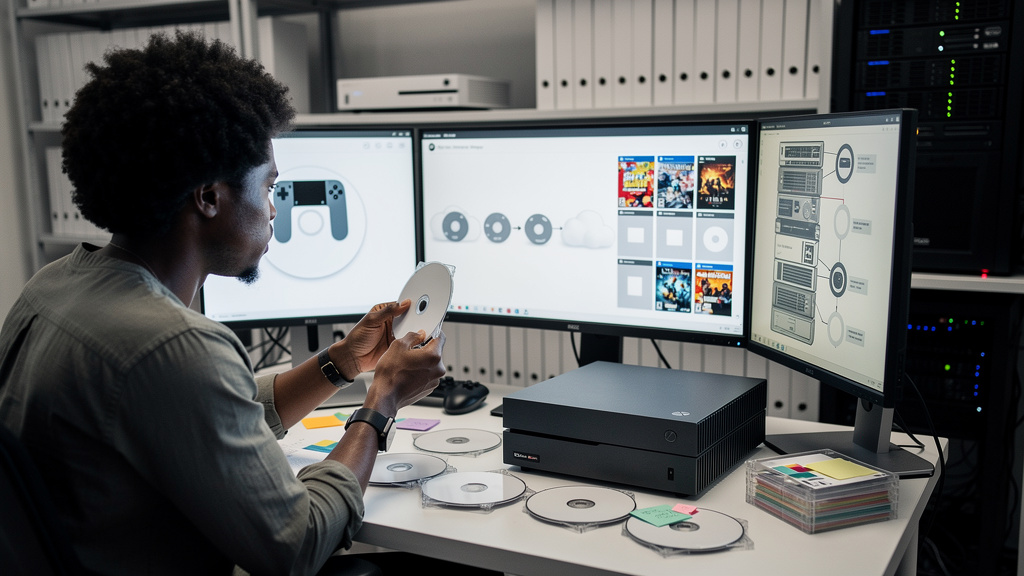
A few years ago I lent my Xbox One to a relative for a week. When it came back, every disc game I owned showed a little lock icon in my library. The discs were on the shelf, the licenses lived on the console, and I could only play the games while that specific box sat under the TV in my living room. The system treated my physical collection like a rental that I had already returned.
Microsoft announced on August 27, 2026 that this is finally changing. The first time you launch a supported Xbox One or Xbox Series X disc, the console records a license that follows your Microsoft account around instead of staying tied to the box you inserted it into. After that, you can put the disc back on the shelf, fire the same title from your library, install it on a Windows PC, or stream it to a phone, browser, or smart TV. Testing opens to Xbox Insiders on August 31, with the general rollout later.
That is a different deal than “free digital games.” You are not receiving anything new. You are receiving the permissions that should have come with the disc in the first place. The physical media still works exactly the way it always did, and you can still resell the disc if you want to.
Three audiences, three different benefits
Collectors who hoard discs for sentimental reasons finally get a unified library without rebuying digital copies. The shelf stays where it is, the games still boot from the disc when you put it in the drive, and the second copy of the library now lives on every device the household owns. That is the use case I think Microsoft is targeting, even if the press release never says it that way.
The family with mixed digital and physical collections stops having to think about which copy of the game goes with which console. The same license unlocks the title across an Xbox, a PC, a phone, and a streaming stick, and the kids can move between devices without losing their saves. That sounds small until you try to manage a household library across two kids and three consoles.
The friend or relative in another city with a console at their place benefits the least directly but still gains something. Once the feature ships, they can record their own shelf copies, and the same Microsoft account plays those titles on whatever device they happen to be sitting in front of. For people who buy physical because they refuse to give up ownership, the recorded license is the next closest thing to a permanent entitlement without paying a second time.
- The collector unifies a shelf library across household devices.
- The mixed-household buyer stops juggling which disc goes with which console.
- The long-distance family member can play shelf copies on any device they sign into.
- The pure-digital buyer sees no change, which is the correct outcome for them.
What the announcement did not say
Microsoft framed this around game preservation, and the corporate phrasing around technology, devices, and distribution continuing to evolve is the kind of line I usually skim. The intent underneath it is worth supporting, though. The point is that games you paid for should keep working when the format shifts around them, and that is a real stance for a console maker to take.
The catch is uneven coverage. The first wave covers thousands of supported titles, not the entire Xbox catalog. Some old discs will not record a license, and there is no public list to check your personal library against before August 31. Region-locked or delisted discs are an open question Microsoft has not answered yet, and storefront-specific versions of multi-platform games may behave differently even when the same title appears on the supported list.
A second quiet concern is what happens if Microsoft ever decommissions the licensing service. Your physical discs would still play on the console you insert them into, but the digital side of the library would stop working. That is the trade-off worth naming out loud, because it is the part of the deal that requires Microsoft to stay in business in a particular way.
- The supported list is thousands of titles, not the full catalog.
- Region-locked and delisted discs are an open question.
- Storefront-specific versions may behave differently from each other.
- Long-term access depends on Microsoft’s licensing service staying online.
How to try it before the general rollout
The August 31 test window is for Xbox Insiders. If you are already in the Insider program, the feature flips on for your account and you can start recording discs on day one. If you are not in the Insider ring, the Insider Hub application on your console is the place to sign up, and the wait for the general rollout should be measured in weeks rather than months.
The actual process is straightforward. Insert a supported disc, launch the game, wait for the system to record the license, and you are done. There is no separate transaction and no code to redeem. The hard part is verifying that the recording actually worked the way you expected.
Put the disc back on the shelf and try to start the game from your library without it. If the title supports Xbox Play Anywhere (a Microsoft program that lets one purchase unlock on console and PC), install it on a Windows PC signed into the same Microsoft account. If it supports Xbox Cloud Gaming (Microsoft’s server-streamed game service), stream it to a phone or browser. That round trip is the only way to confirm the recording worked across all three surfaces, and it is the part of the process most people will skip.
- Sign up through the Insider Hub on your console if you are not already enrolled.
- Insert a supported disc, launch once, and wait for the license to record.
- Verify disc-free play, the PC install via Play Anywhere, and a Cloud Gaming stream.
Trade-offs
The clearest upside is that existing physical libraries become more useful without paying for digital copies again. People who only buy digital see nothing change, which is the right outcome because they had no friction to remove in the first place. For people who buy physical because they want to hold onto the games indefinitely, the recorded license is the closest thing to real ownership Xbox has offered since everything moved to the digital store.
Uneven coverage is the cost. The supported list is not public yet, and some discs will not record. There is no way to know which ones until the list ships. Region-locked and delisted titles are the obvious gaps, and Microsoft has not said whether they will be addressed at all.
Long-term dependence on Microsoft’s licensing service is the second trade-off. The disc still works without it. The digital side does not. That is the deal you are accepting when you record the license, and it is worth being honest about it.
- Coverage is uneven until Microsoft publishes a supported list.
- Region-locked and delisted discs are an open question.
- Long-term access depends on Microsoft’s licensing service staying online.
- People who only buy digital see no benefit, which is the correct outcome.
What I would tell past me
Three specific lessons from watching Microsoft roll out similar entitlement features and from helping family members manage physical game collections.
- Pick one or two discs for the first round. Trying to record thirty titles at once makes it harder to verify whether each one really did what you expected. Two discs gives you enough variety to spot a problem without burying it in noise.
- Test on a second device before you trust the recording. A successful registration on the console means nothing until you confirm the PC install or Cloud Gaming stream actually fires. Spend ten minutes on the second device before you count it as working.
- Do not throw out your physical discs even after a successful recording. The recorded license is convenient, but the physical disc is the only copy of the game that does not depend on Microsoft’s servers. Keep both, and you are covered either way.
For anyone who bought physical games because they wanted to hold onto them indefinitely, this is the closest thing to ownership on Xbox since everything moved to the digital store. The disc stays in your collection, the recorded license follows your account, and your library finally behaves the way collectors have always wanted it to. None of this changes the fact that the digital side still requires Microsoft to keep the licensing system alive, which is the trade worth naming before you start your recording queue.