
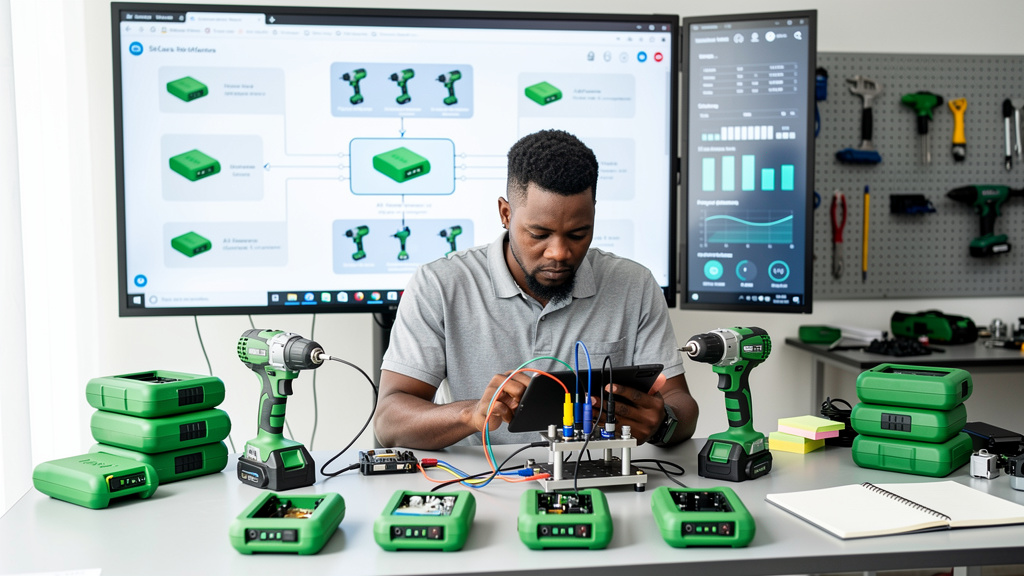
I was about to spend $39 on a Ryobi screwdriver that did not fit any battery I already owned. The price was right, the brand was right, and the green paint matched the drill sitting in my toolbox at home. None of that mattered, because the little screwdriver in my hand had a built-in 4V cell that charges through a USB-C cable on the side, and the drill at home has a slide-on 18V pack. There was no way to make them work together. I put the box back on the shelf and went home to write this article so other people could avoid the same trip.
The mistake that costs you a charger
Ryobi’s lineup is a study in branding over compatibility. The same shade of green appears on tools that share nothing under the hood. There are four distinct battery platforms under the Ryobi name, and three of them are completely sealed off from each other. A buyer who walks into a hardware store expecting a unified system walks out, on average, with a tool that does not work with anything else they own.
The brand does not hide this. The information is on the box. But it lives in a small label that most people never think to look for, and the visual identity of the packaging pulls attention toward the brand mark instead. By the time you have read the front of the box and decided whether you like the tool, you have probably already missed the part that tells you what you are committing to.
The 1996 system that actually delivers on its promise
ONE+ is the only Ryobi platform where the cross-tool promise is real. It launched in 1996 as an 18V slide-on battery rail (a battery that physically slides onto the bottom of the tool and locks into place), and Ryobi has never redesigned the mounting interface. Every pack in the ONE+ line fits every tool in the line, and the product catalog now includes more than 300 tools. That compatibility is the entire reason a homeowner buys into ONE+ instead of choosing a different brand.
If your existing Ryobi tools say ONE+ on the battery, you can buy any other ONE+ pack on the shelf and it will work. That includes packs you have never seen before, packs from other product lines, and packs that came out years after you bought your drill. The slide-on rail has not changed in 30 years.
The three platforms that share nothing with ONE+
40V is the first of the three. It is built for outdoor equipment that pulls high sustained current, the kind of demand that overheats an 18V pack. Leaf blowers, string trimmers, mowers, anything in the yard tool family. The packs are physically larger, the chargers live on a different shelf, and the tool mounts do not accept ONE+ packs. A buyer who owns ONE+ tools and buys a 40V tool is starting a second collection, with a second charger and a second battery budget.
80V is the second. It is even bigger, built around riding mowers and heavy outdoor equipment. The packs are heavier, the chargers are different, and the tools do not talk to any of the smaller Ryobi systems. Most people who own an 80V tool already know this. Most people who do not will never own one.
USB Lithium is the third, and it is the trap that caught me in the tool aisle. The name implies a charging standard, the way USB-C implies a port on a laptop. In Ryobi’s catalog, USB Lithium means something different. It is a 4V line of small precision tools, including screwdrivers, rotary tools, glue pens, and inspection lights. The battery is built into the tool body. The tool charges through a USB-C cable. There is no slide-on rail and no swappable pack, which means there is no compatibility with ONE+, 40V, or 80V.
What the small label is actually telling you
The fastest way to figure out whether a Ryobi tool belongs to your existing collection is to read the platform label on the box. It is usually in the corner, in small text, and it is the only part of the packaging that tells you the truth about battery compatibility.
If the box says ONE+, the tool accepts every ONE+ pack you already own. If it says 40V, 80V, or USB Lithium, it does not. That is not a missing accessory or a separate purchase. It is the design of the platform, and there is no adapter that closes the gap.
When the platform label is hard to find, treat that as a signal. A brand that wants you to know which system you are buying into would put that information on the front of the box. A brand that buries it in a corner is counting on you to assume compatibility based on the paint.
The order I follow in the Ryobi aisle
I check the platform label before I look at the price. If the platform does not match what I already own, I keep walking. The only exception is USB Lithium, which is genuinely a self-contained tool that does not need a battery infrastructure. For everything else, no match means no buy.
Once the platform label checks out, I confirm the battery type. ONE+ tools come in different voltage ratings and amp-hour sizes, but they all fit the same rail. I look for a pack that fits my existing chargers and budget. The exact tool features come after that.
Here is the checklist I actually run through before I add anything to the cart:
- Platform label on the box matches what I already own (ONE+, 40V, 80V, or USB Lithium).
- Battery type is compatible with at least one charger already on my workbench.
- I already own two or more packs in that platform, or I am committing to start a new collection on purpose.
- The tool is something I will use at least monthly, not a one-off purchase that justifies a new platform.
If any of those checks fail, the tool goes back on the shelf.
Brushless motors (motors controlled electronically instead of using physical carbon brushes, which usually run cooler and last longer), HP brushless, Whisper Series, and other premium sub-labels are real differences, but they are second-tier considerations. The platform match is the decision that determines whether the tool joins your collection or starts a new one.
If I do not already own at least two batteries and a charger for the platform the new tool belongs to, I skip it. Adding a brand-new platform for one tool is almost always a waste of money, because the charger alone takes up more outlet space than the tool saves in convenience.
Trade-offs
ONE+ has limits worth naming. The slide-on design dates to 1996 and the packs reflect that age in a few ways. Capacity tops out lower than some competitors in the same price range. Cold weather performance is acceptable but unremarkable. Heavy-duty work like running a circular saw for extended periods will pull the pack into thermal protection (a safety feature that cuts power when the battery overheats) faster than a premium battery would.
The pack size is also a consideration. ONE+ packs are not as compact as some competitors, and that matters when you are using a tool for overhead work for an hour at a time. The chunky pack on the bottom of the drill is a real ergonomic factor.
The 40V and 80V systems are fine tools on their own merits. They are not bad products. They are just not part of the ONE+ family, and a buyer who treats them as ONE+ extensions ends up with two collections instead of one.
USB Lithium is a useful format for the small tools it covers, but it is also a dead end. There is no adapter, no shared pack, and no upgrade path. You buy the tool with its built-in cell and you replace the whole tool when the cell eventually wears out.
What I would tell past me
If you are just starting with Ryobi, buy ONE+ and ignore everything else until you have a specific reason to expand. The other platforms work, but they do not interact with your ONE+ collection in any meaningful way. The fastest way to waste money on this brand is to treat every green box like part of the same family. They are not. ONE+ is the only Ryobi label where the cross-tool promise holds, and that promise is the only reason the brand is worth committing to in the first place.