
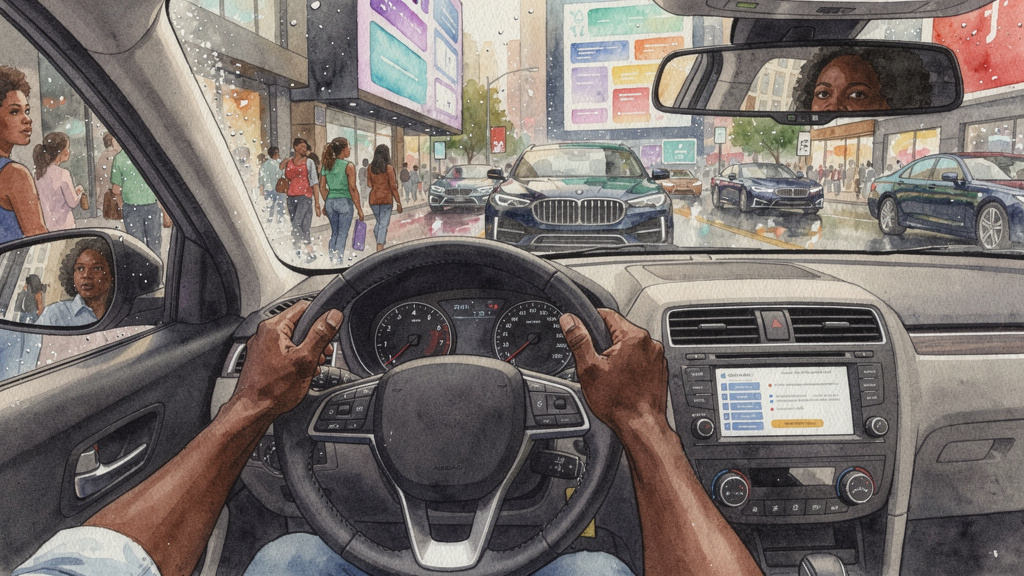
I test-drove a $92,000 luxury SUV last fall and walked out of the dealership thinking two things. The first was that the seats were nicer than the couch in my living room. The second was that the infotainment system had a Spa Mode, and I am not making that up. It is a real button. It adjusts ambient lighting, plays waterfall sounds over the speakers, and pipes a faint lavender scent through the climate control. I sat in a parked SUV in a dealership lot for fifteen minutes, breathing lavender, and the entire experience was the clearest argument I have ever seen for buying a $35,000 car instead.
This is not a rant about luxury cars. People who can spend $92,000 on a car are free to spend $92,000 on a car, and some of them genuinely need the towing capacity or the third row. This is a post about tech bloat (the practice of adding software features, screens, and subscription services to a vehicle that do not improve the core job of driving) hitting the automobile industry, and the specific way it is going to cost you money for the next ten years if you are not paying attention. The $92,000 example is real, but the same pattern is showing up in $40,000 cars. It is just less obvious because the seats are not as nice.
The screens are not the problem
The first thing people complain about with modern cars is the touchscreen. Touchscreens are not great for adjusting climate control while you are driving, and they are worse for the things you do once and then never again, like pairing a phone. I have read at least forty forum posts about this, and the consensus is the same. Knobs are better. Physical buttons are better. Voice control is mostly a joke.
But the touchscreen itself is not what is going to cost you money. Touchscreens are a one-time complaint. You learn the menus, or you do not, and you move on. The thing that is going to cost you money is the software subscription that comes with the screen.
Take a recent example. A major German automaker started requiring a $25 per month subscription to use the heated seats that are already physically installed in the car. The hardware is in the seat. The wiring is in the seat. The button to turn them on is in the car. You just have to pay $25 a month to unlock the software that lets the button work. The subscription does not turn on a server. It does not stream anything. It is a flag in a database. The car already has the feature. You are paying for permission to use it.
I am not going to name the automaker, because the practice is spreading, and singling out one company lets the others pretend they are not doing it. As of early 2026, at least four major brands have either rolled out or announced similar subscription-locked features. Heated seats. Adaptive cruise control. Even remote start on some models.
The data collection is the bigger problem
The screens are annoying. The subscriptions are expensive. But the data collection is the part that worries me most, and it is the part that nobody talks about because it is invisible.
Modern luxury cars collect a staggering amount of data about how you drive. Where you go. How fast you go. How hard you brake. Whether you wear your seatbelt. Whether you have a passenger. Some of this data is shared with insurance companies, who use it to adjust your rates. Some of it is shared with the manufacturer, who uses it for product development. Some of it is sold to data brokers, who resell it to advertisers, who use it to figure out what to put in front of you on the next website you visit.
A friend of mine works in insurance. She told me that the gap between the cheapest and most expensive driver on the same policy used to be about 30%. With modern telematics (the system that collects and transmits driving data from your car to a server, often without a clear opt-out), the gap is now closer to 300%. The good drivers pay less. The bad drivers pay more. The problem is the definition of “bad driver” has expanded. Hard braking once for a deer is now an event. Late-night driving is now a risk factor. A road trip is now a pattern.
If you are a careful driver, this is good news. If you are not, your insurance is going up. And if you are somewhere in the middle, the insurance company is going to decide which side of the gap you are on, and you do not get to negotiate.
The features you do not need
Here is a list of features I have personally used in modern cars, and how often I used each one after the first month.
- Spa Mode. Used twice. Mostly to show it off to friends. I cannot recommend spending $92,000 to show off a feature to friends.
- Massage seats. Used weekly. Genuinely nice on long drives. Not $40,000 nice.
- Augmented reality head-up display. Used daily. Genuinely useful. Available on cars in the $35,000 range.
- In-car Alexa or Google Assistant. Used rarely. Phone does the same thing and is closer to me.
- Adaptive suspension. Used daily, but I would not have noticed it was missing if I had never had it.
- Heated armrests. Used once, to confirm the feature existed. Then never again.
- Wireless phone charger. Used daily. This is a great feature. I will miss it on older cars.
- Wi-Fi hotspot. Used twice. Phone hotspot is faster, cheaper, and not locked to one car.
The pattern is clear. About a third of the features I paid for turned out to be useful. Another third were neutral. The last third were actively bad, in the sense that I would have preferred they not be there at all. A simpler car with a longer feature list is not actually a better car.
What I would buy instead
If I had $92,000 to spend on a car today, I would spend $35,000 on a midsize SUV with the options I actually use, and put the remaining $57,000 in an index fund. The car would have a real volume knob. It would have physical climate controls. It would not have a Spa Mode. The seats would be cloth, and they would be fine.
I would not lease it. Leases are designed to make the monthly payment look smaller than the total cost, and they end with a used-car transaction where the dealer has all the bargaining power. I would buy it outright, or finance through a credit union at a saner interest rate.
I would read the fine print on the connected services before signing anything. If the car requires a subscription to use the features I am paying for, I would buy a different car. The list of cars that lock features behind subscriptions is growing, but it is not universal. There are still brands that sell you a car and let you keep it.
Trade-offs
A $35,000 car is not free. The resale value is lower, the interior is not as nice, and the warranty is usually shorter. The cloth seats will stain if you have kids or dogs, and the sound system will not impress anyone. Adaptive cruise control is optional on most trims, and the head-up display usually requires stepping up to a higher trim level.
Insurance and data collection depend on the driver. If you are careful with a clean record, modern telematics will probably save you money. If you are not, the same telematics will charge you more than the old system would have. I drive about 12,000 miles a year, mostly highway, mostly during the day, and the telematics discount I qualified for is real. I am not going to refuse the discount on principle. But I am also not going to buy a feature I do not need just because the data it generates will save me $80 a year on insurance. The math does not work out.
If you are a luxury car buyer with a specific need the cheaper car cannot meet, the $92,000 SUV is fine. Towing capacity, third-row seating, off-road capability, and high-performance driving are all real reasons to spend that kind of money. The trade-off is that you are also paying for the Spa Mode whether you use it or not, and the data collection is happening whether you opted in or not. The cheaper car does not save you from data collection entirely, but it is harder for the manufacturer to justify aggressive collection without a paid subscription service attached.
If you have always bought new, this is the year to consider used. Three-year-old luxury cars are now 50% of the original sticker price, and tech-heavy vehicles depreciate faster than simpler ones. You get the nicer interior for less, and the previous owner already paid for the depreciation.
What I would tell past me
If I could send a message back to the version of me that walked into the dealership last fall, I would say three things.
- Test the buttons before you test the seats. A real volume knob, real climate controls, and a physical gear selector are worth more than leather. The buttons get used every day. The seats get used once.
- Read the data policy before you sign. Most manufacturers will sell your driving data to data brokers unless you opt out, and the opt-out process is usually buried in a settings menu. Find it before you take delivery. If the process is not there, that is information too.
- Do not pay for features you have not used yet. Spa Mode sounds nice in the showroom. Lavender scent sounds nice in the showroom. The car will tell you what you actually use after the first month, and it is almost never the things the salesperson emphasized.
The simpler car will not impress anyone in the parking lot. It will not have a Spa Mode. It will not have augmented reality. It will be a $35,000 car, and it will do the job a $35,000 car is supposed to do, and the money you did not spend will be in an index fund earning 7% a year. That is the car I am buying next time.