
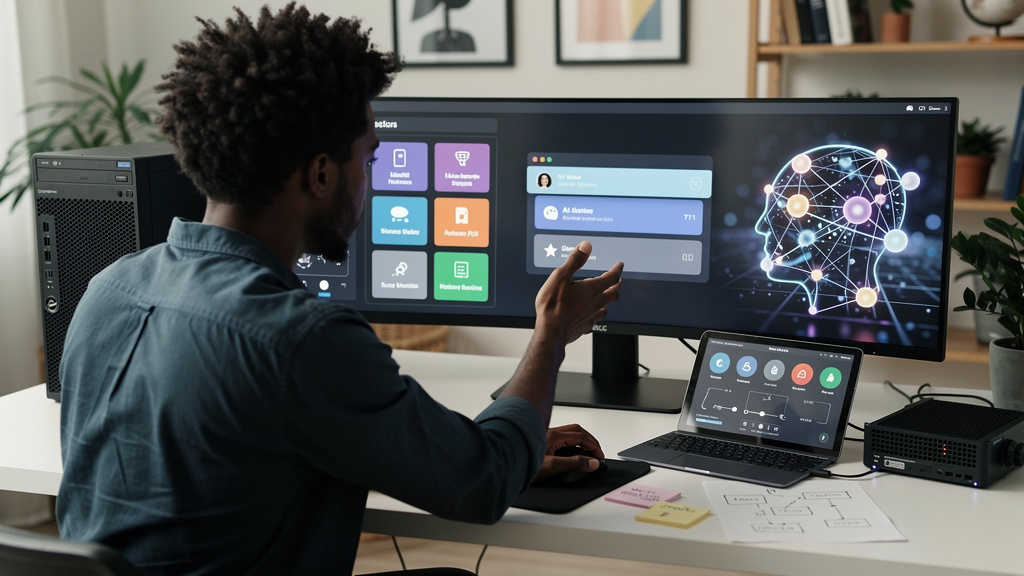
Every few years a new generation of personal computers shows up with a fresh acronym on the spec sheet and a fresh pitch from the manufacturers. The pitch is always the same. Faster, thinner, longer battery, smarter about your day. Most of the time the pitch is wrong, because most of the time the laptop is just a slightly faster version of the laptop you already own. The current wave is different, and the reason it is different is not what the manufacturers are saying.
Here is the part nobody puts on the keynote slide. The new wave will sell because the software requires it. Every other wave in the last decade sold because the hardware was slightly nicer than last year’s hardware. This wave will sell because the software will quietly stop working on your old machine, and the upgrade will not feel optional.
The chip is interesting, but the software is the story
The new wave has a specialized accelerator on the main board. The marketing name varies by vendor, but the function is the same. It is a small processor tuned for the math that large language models and image generators rely on, sitting alongside the main CPU and saving the main processor from doing work it was never designed to do. On Apple machines the equivalent has been shipping for years without anyone writing a press release about it. On Windows laptops the chip is the headline.
What matters for buyers is what the chip lets the software do. A laptop with the new accelerator can run background noise removal that does not choke the rest of the system. It can summarize a long document without pinging a remote server. It can generate or edit an image locally, in seconds, without uploading your source file to a third party. None of that sounds dramatic on a marketing slide. All of it feels different when you have actually used it for a week.
- Background tasks that used to pin the CPU now run silently on the local accelerator
- Prompts and source files stay on the device, which changes the privacy math
- Image and audio generation move from novelty to something you would actually open every day
- Battery life improves because the main processor is no longer carrying the whole load
- Offline use becomes realistic for serious workloads, including on a plane
That last point is the one I keep coming back to. A laptop that can do real work without a network connection is a laptop that does real work in more places. The pitch for the new wave is not speed. The pitch is location.
The vendors are not all in the same boat
If you assume the obvious winners from a new wave of personal computers are the chipmakers, you are right, but only halfway. Three vendors are integrating the new accelerator into the bulk of their laptop lines, and they are not all in the same financial position.
The two largest CPU vendors are pushing the new accelerator into mid-range and premium laptops as a standard feature, which raises their bill of materials and squeezes their margins unless retail prices can move with them. A third vendor, working from an ARM-based design, is taking a different angle and competing on battery life and weight. A fourth vendor, whose laptops you may already own, is shipping a competitive accelerator quietly in every new machine, with no marketing line item for it.
The interesting question is not who has the fastest accelerator. It is who can keep the price of a finished laptop below the line where buyers start walking away. Memory costs are the variable that decides that line. When memory gets cheap, vendors absorb the cost of the new accelerator and the upgrade cycle hums. When memory stays expensive, vendors have to choose between thinner margins and thinner demand.
A second tier of winners sits behind the chipmakers, and most coverage misses them entirely. Memory suppliers ride the same wave, sometimes harder. When every new laptop wants more RAM than the generation before it, the people who make the RAM do well even if the chipmakers do not. That asymmetry is the kind of thing that shows up in the financial pages months after the consumer pages have moved on.
The OEMs are caught in the middle
The laptop brands are the ones who have to explain all of this to a buyer in a store. They also have to decide which models get the new accelerator, which models get the cheaper display, and which models get the slightly thicker chassis that holds more memory. None of those decisions are popular with the marketing team.
Brands that already have a clean split between premium prosumer lines and budget lines have an easier time. They can put the new accelerator on the premium tier where the price can absorb the cost, and leave the budget tier alone until component costs come down. Brands that try to put the accelerator on every model from the cheapest to the most expensive tend to get squeezed on both ends. The cheapest model cannot carry the cost, and the most expensive model does not gain enough to justify the price.
- Premium prosumer and enterprise buyers absorb higher prices first
- Student and casual buyers hold existing machines longer when prices rise
- Mid-range models are where the margin squeeze shows up most clearly
- Enterprise refresh cycles become the largest single source of unit volume
- Brands with a clear tier strategy will outperform brands trying to be everything to everyone
Software decides who has to upgrade
The piece that I think the chipmakers and OEMs are underestimating is the software side. Operating system vendors are quietly starting to ship features that require the new accelerator. Image editors are adding generation tools that default to running locally. Office software is starting to assume you have a fast on-device summarizer. None of those features are mandatory today. All of them will be mandatory within three years.
That is the upgrade cycle that has been missing since the ultrabook era. Buyers do not replace a laptop because it is slow. Buyers replace a laptop because a piece of software they rely on every day stops working on it. When the operating system quietly raises its floor, the upgrade cycle turns on. When the operating system quietly leaves the old floor in place, the upgrade cycle stays frozen.
The companies to watch are the ones shipping the software, not the ones shipping the silicon. Operating system vendors, productivity suites, and creative tool makers all hold the keys to when the new accelerator becomes a requirement rather than an option.
What this means if you are buying or watching
Buyers should wait unless their current machine cannot do something they need today. The next lineup will be meaningfully better, and prices will likely settle as memory supply catches up. The exception is anyone who needs on-device generation or summarization for work that involves sensitive source material. Those buyers will find the new accelerator changes the privacy math enough to be worth the cost.
Investors and analysts should pay closer attention to the boring picks. Memory suppliers ride the same wave as the chipmakers and sometimes ride it harder. Software platforms decide when the upgrade cycle turns on, and their choices shape the cycle more than any chip announcement. The glamorous names will get the headlines. The unglamorous names will get the margins.
Anyone shipping a product that runs on a personal computer should start asking now whether their roadmap depends on the new accelerator. The hardware will arrive. The question is whether the software will be ready to take advantage of it, or whether the team will be scrambling to catch up when the floor quietly rises.
Trade-offs
Betting the new wave on software rather than silicon has trade-offs that are worth naming.
- Software-led adoption is slower at the start because there is no single moment when buyers have to upgrade
- Vendors who rely on software partners do not control the timeline and have to wait on someone else’s roadmap
- The privacy benefit of on-device work is real but only matters to buyers who already care about privacy
- Memory cost remains the variable that can break the math, and memory cost is set by a small number of suppliers
- The unglamorous winners will be ignored by consumer press for most of the cycle, which makes them harder to find
What I would tell past me
The new wave of personal computers will sell because the software requires it, not because the silicon is exciting. The chipmakers are the obvious winners, but they are not the only winners, and they are not the biggest winners if memory costs stay high. The boring picks will outperform the obvious ones, and the upgrade cycle will turn on when the operating system raises the floor, not when the marketing team ships a new spec sheet.
Three signals to watch over the next twelve months. Accelerator performance in mid-range laptops. The price of the memory that every new laptop needs more of. The pace at which major software starts treating the new accelerator as required rather than optional. Those three signals will tell you whether this becomes a real upgrade cycle or just another spec bump that flattens out.
Source: https://fosspost.org/the-ai-pc-boom-who-could-benefit-financially-in-2027/