
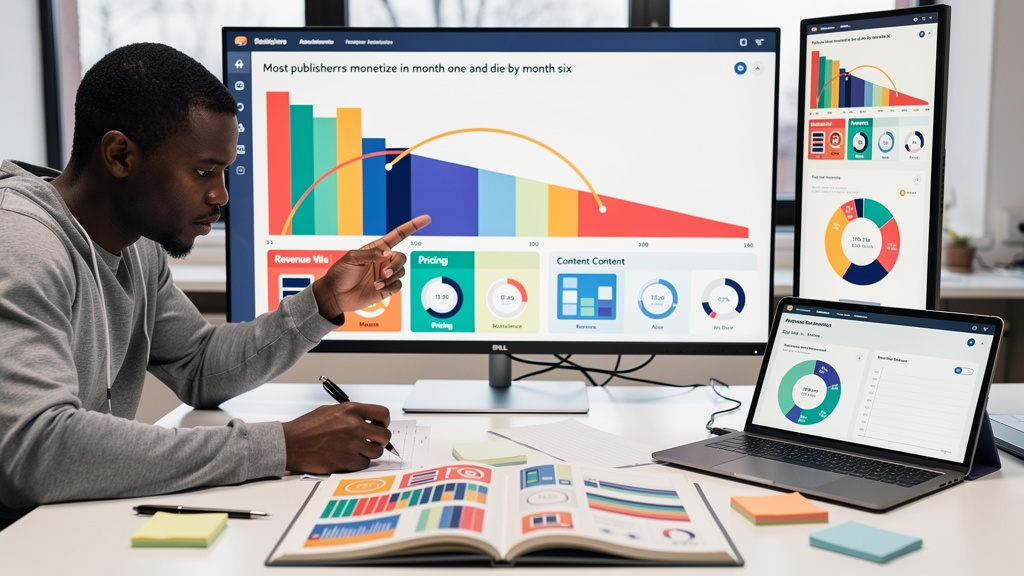
I have watched plenty of small publishers turn on Google AdSense in their first month of writing and lose a chunk of their returning traffic by month six. The pattern is the same each time: the dashboard keeps saying revenue is up. The audience quietly says something else. That gap between dashboard and reality is the whole story about running ads on a young site, and almost every mistake on the way to that gap is invisible until your repeat-visitor graph starts sloping down.
If you are about to add your first ad network, take a beat. There is a six-month arc that nobody warns you about, and almost every mistake on that arc is reversible if you catch it early and irreversible if you do not.
Why the first ad tag is a load-bearing decision
The day you turn on ads is the day you start renting out part of your reader’s attention. That sounds obvious, but most publishers treat it like flipping a switch on a money printer. It is not. You are selling a specific reader’s time, in a specific moment, to advertisers who care deeply about who that person is and what they might buy next. The IAB’s 2024 report put US digital ad revenue at $258.6 billion, and almost all of that flows to a small number of well-targeted audiences. A million impressions from the wrong readers can be worth less than ten thousand from the right ones.
So the first question is not which network to pick. The first question is who your reader actually is and what advertisers want to buy from them. If you cannot answer that in one sentence, you are not ready to turn on the first network.
Six audience dimensions advertisers use to value the readers you built:
- Geography and language. Most buyers want US, UK, Canada, Australia, and a few Western European countries.
- Device split. Mobile-heavy traffic monetizes differently than desktop-heavy traffic, with ratios that depend on the niche.
- Topic and buyer fit. Niche readers tend to be worth more to advertisers than general readers. The exact multiplier varies by vertical; the direction is consistent.
- Engagement depth. Time on page and scroll completion matter more than session count.
- Loyalty. A returning visitor is generally worth more per session than a one-time click.
- Source channel. Search and direct traffic usually pay better than social referrals.
If you have not measured your audience on those six dimensions yet, pause. You cannot make format decisions before you know what you are selling.
Why loading every format at once is the worst move
The mistake I see most often is loading every format at once. A new publisher reads a thread about header bidding on a Tuesday night, signs up for half a dozen networks by Friday, drops in three sticky placements, autoplay video, and a push notification opt-in over the weekend. Six to eight weeks later the bounce rate is up, the average session is shorter, and per-page revenue has flatlined because advertisers quietly downgrade junk inventory.
Pick fewer formats. Treat each placement like a feature, not like wallpaper. A short list of what actually works:
- One display slot above the fold, below the title. Never above the title.
- One in-feed native unit. Only if you actually review what runs on it.
- Autoplay video and push notification opt-ins. Mobile readers close the tab. Drop both.
- No sticky sidebars on mobile. They cover the content and always feel spammy.
If the choice is short-term revenue versus the trust that keeps a reader coming back over the next two years, take the trust. You can always add more ad slots later. Getting a reader back after they bounce because the page felt like a billboard is a much harder sell.
The privacy angle most new publishers miss
The networks with the highest CPMs are often the ones running shoddier creative or leaning on tracking that breaks under new rules. The safer baseline (AdSense is the common choice) pays less per impression but holds a higher floor on what shows up on the page. Open exchanges can pay more, but the floor is lower and bad actors do slip through.
The trade-off here is sharp. Tighter partners often pay less per impression but bring cleaner creative and fewer regulator concerns. Looser partners pay more but drag in complaints and bad actors. A working approach is to layer in two or three partners, pin each one to a specific spot on the page, and let the data run for at least a month before you touch anything. Resist the urge to optimize in week one. The networks are still learning your audience, and the early revenue numbers will mislead you if you read them as a verdict.
How to know whether ads are actually working
RPM (revenue per thousand impressions) reads well on a slide and serves poorly as a goal. If you optimize for RPM alone, your traffic will skew toward bots and clickbait referrers that pad the dashboard while your real readership quietly disappears.
Five metrics that actually tell you whether monetization is healthy:
- Viewable impressions, not just served impressions. Half of served impressions are never actually seen by anyone.
- Session length and pages per session, tracked month over month. The canary in the coal mine.
- Returning visitor rate over a rolling 30 days. The single most honest audience-health metric.
- Click-through rate on ads. Very low CTR usually means the ads are intrusive or off-topic.
- Reader complaints in the inbox. A spike here precedes a traffic drop by about a month.
If two of those go in the wrong direction at the same time, whatever you just turned on is costing you more than it brings in. Roll it back.
Compliance is no longer optional
A few years back you could get away with a thin privacy page and a small cookie banner at the bottom of the site. That window is closing fast. Privacy rules in Europe and at the US state level, along with platform terms, now require explicit disclosure, working consent, and a clear answer to the question of what you actually collect through ads. If you run AdSense or any programmatic partner, you are forwarding visitor data to outside companies, and you are the one responsible for telling visitors in plain English.
Treat the privacy page as a product surface, not a legal afterthought. It is part of what readers are actually buying when they stick around.
Trade-offs
Adding ads early is not free in reader trust. Picking fewer formats is not free in monthly revenue. Choosing stricter networks is not free in CPM (cost per thousand impressions). The math always leans toward short-term revenue, and that is the trap.
For a small publisher just starting out, my suggestion is to run a six-month clock before turning on the first network. Build the audience, learn what they read, then add one display slot and one in-feed native unit. Watch the metrics above for a full month before adding the next thing. That pacing costs you some short-term revenue you would have earned earlier, and it buys you a clean baseline you can compare future changes against.
The publishers who win long-term monetization are the ones who treat it like a system you tune, not a switch you flip.
What I would tell past me
If I could send a message back to the version of me that was about to paste an AdSense snippet on a brand-new site, I would say three things:
- Wait six months. Build the audience first. The first ad unit always feels like progress and almost always costs you trust you cannot measure.
- Pick two networks, not six. The marginal revenue from the third network is not worth the trust hit from the format sprawl.
- Watch returning visitor rate more than RPM. RPM is a vanity number. Returning visitors are the audience you are actually building.
Monetization is a system you tune. The publishers who survive a year three traffic dip are the ones who treated it that way from day one.