
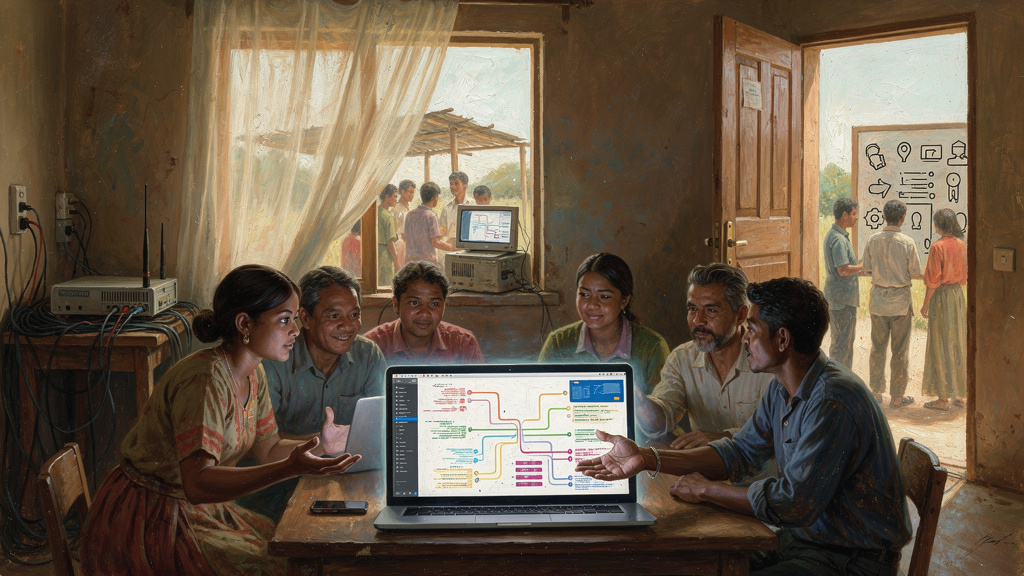
3 key open source challenges in developing countries
I spent two years working on open-source deployment projects in West Africa and Southeast Asia, and the patterns I saw on the ground are not the patterns the Western open-source community usually talks about. The challenges are real, they are not technical in the way most developers expect, and the people closest to them are not always the ones with the loudest megaphones in the global open-source conversation. I want to lay out the three challenges I saw most often, what I learned trying to solve them, and what I would do differently if I went back.
The connectivity problem is not the connectivity problem
The first challenge people name is internet connectivity. It is real, but it is not the most important one, and the open-source community has gotten better at the technical side of this over the last decade. Offline-first apps, mesh networks, and cached content distribution are well-understood. The harder version of the challenge is power: inconsistent electricity, both for charging phones and for running the small server or laptop the deployment runs on. A laptop with a four-hour battery is not a four-hour device in a region with two-hour daily power cuts; it is a two-hour device. A small solar panel and a power bank, a hundred dollars at most in the local market, does more for a deployment than any code change.
Bandwidth cost is the next version of the challenge. A software update that is “small” in a European frame, say a 50 MB app, is an hour of prepaid mobile data in many parts of the world. A deployment strategy that assumes the user has Wi-Fi is a deployment strategy that only works for the 10% of the population with reliable home internet. The pattern that worked best across all the projects I worked on was delta updates: send only what changed, not the full package. apt-delta, OSTree (a tool that ships OS images in a way that lets devices update only the changed bytes), and rsync-based image deltas are the right primitives here. Most open-source projects do not have them. That is a real gap.
Latency is the third version. Even where the connection is reliable, the round-trip time to the nearest cloud region is 200-400 ms, and a lot of modern web stacks are designed for 50 ms. A deployment that is “fast” in San Francisco can be a three-second wait on every page load in Lagos. Static site generation, edge caching, and aggressive prefetching do not fix this; they hide it for the first page and then the user hits a dynamic endpoint and waits. The real fix is to push as much of the stack onto the device as possible, and to make the network calls bursty rather than chatty.
The language problem is structural
Open source is written in English. The issues, the documentation, the commit messages, the chat conversations, the conference talks. For a developer whose first language is Yoruba, Khmer, or Quechua, the gap between “I can use this software” and “I can contribute to this software” is enormous. I worked with three developers who could read English well enough to use an open-source project, but who could not write English well enough to send a clear pull request description, and who were not confident enough to participate in an English-language community chat. Their work was solid. The language barrier was the only thing keeping them from contributing.
The fixes I have seen work:
- A bilingual contribution guide. English on one side, a local language on the other. The community translates it; the project ships both.
- A “first PR” mentorship program that pairs a non-native English speaker with a patient reviewer who is willing to spend an extra round on wording.
- Code comments and commit messages in the local language, with English summaries above them. The code review tooling is language-agnostic; the community conversation is not.
- Translating the project documentation through a tool like Weblate (an open-source translation platform), not as a one-time project but as a continuous practice.
Visibility rewards in the open-source community are correlated with native English fluency, and that is a structural bias the community has not yet found a way to compensate for. The work to fix this lives in the project, not in the abstract: a bilingual contribution guide, a patient reviewer for first-time contributors, a documentation pipeline that treats translation as a continuous practice rather than a one-time project. None of these are technically hard. All of them require a maintainer who is willing to invest the time.
The funding problem is not the funding problem
Maintainer funding is the challenge the open-source community has been most vocal about, and it is real. A full-time maintainer in a high-cost-of-living country cannot pay rent on GitHub Sponsors alone, and a part-time maintainer cannot put in the time the project needs. The proposed solutions, foundations, sponsors, and grants, are the right shape, and the money is starting to flow through the Open Source Collective, the Sovereign Tech Fund, and other intermediaries.
The version of the funding problem I saw on the ground was different. It was not “the maintainer cannot afford to keep working on the project.” It was “the local deployer cannot afford to keep deploying the project.” A school that is running a small open-source learning management system on a donated laptop, with a teacher who is also the system administrator, does not have a “maintainer funding” problem. The teacher has a “the laptop is dying and the school has $200 in the budget for the year” problem. The maintainer is in Berlin and does not know this school exists. The fix is not more maintainer funding; it is a deployment support network, and that is a different kind of organization.
What worked:
- A regional open-source meetup that doubled as a deployment support channel. The maintainer attended remotely; the local deployers attended in person; the conversation was about how to fix the specific failures the local deployers were seeing.
- A small grants program, $500-$2000, run by a local foundation, that paid for replacement hardware, training, and travel to conferences. The grant was small by Western standards; it was transformative at the local level.
- A simple, public “deployers list” on the project website. The maintainer published it, the deployers added themselves, and the deployers started talking to each other directly. Six months later, two of them had co-authored a deployment guide that was better than anything the maintainer had written.
These are not maintainer-funding mechanisms. They are deployment-funding mechanisms, and the open-source community has barely started to build them.
Trade-offs
The honest trade-off in all of this is that the work I am describing is slow, local, and hard to scale. A global maintainer who spends a year on translation, deployment support, and regional grants is a maintainer who is shipping fewer features. The open-source community has consistently chosen to reward the maintainer who ships features, and that is not an unreasonable choice. The trade-off is that the projects that invest in this work have a smaller feature surface and a larger user base. The projects that do not have a larger feature surface and a smaller user base, and the smaller user base is concentrated in the parts of the world with the most resources to pay for the work.
I do not have a clean answer to this. I have seen the trade-off play out, and I have seen both sides. The honest version is that the open-source community is going to have to choose, project by project, whether the goal is “ship the next feature” or “serve the next user.” For some projects the answer is clearly the former. For some projects the answer is clearly the latter. The mistake is pretending the trade-off does not exist.
Bottom line
The three challenges I saw most often were not the ones the Western open-source community usually names. They were:
- Connectivity, but with the real bottleneck being power, bandwidth cost, and latency, not just raw signal.
- Language, with the structural bias that a non-native English speaker has a much higher bar to clear before they can contribute, not just to clear before they can use.
- Funding, but the funding problem is often at the deployer level, not the maintainer level, and the community has barely started to build the deployer-funding mechanisms.
If you maintain an open-source project and you want to do something about this, the work is local and slow. Pick a region, find a deployer, build a relationship, and put in the time. It is not glamorous work. It is also the work that actually expands who gets to use the software. For anyone who has ever written an open-source project because they wanted the world to use it, that is the work that matters.